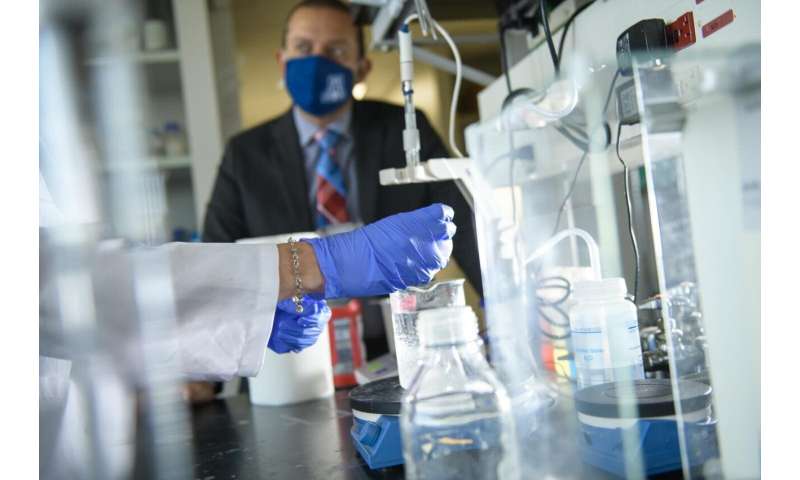
Doctoral student Lisa Boinon prepares buffers while Dr. Rajesh Khanna looks on. Credit: University of Arizona Health Sciences, Kris Hanning
SARS-CoV-2, the virus that causes COVID-19, can relieve pain, according to a new study by University of Arizona Health Sciences researchers.
The finding may explain why nearly half of people who get COVID-19 experience few or no symptoms, even though they are able to spread the disease, according to the study's corresponding author Rajesh Khanna, Ph.D., a professor in the College of Medicine—Tucson's Department of Pharmacology.
"It made a lot of sense to me that perhaps the reason for the unrelenting spread of COVID-19 is that in the early stages, you're walking around all fine as if nothing is wrong because your pain has been suppressed," said Dr. Khanna. "You have the virus, but you don't feel bad because you pain is gone. If we can prove that this pain relief is what is causing COVID-19 to spread further, that's of enormous value."
The paper, "SARS-CoV-2 Spike protein co-opts VEGF-A/Neuropilin-1 receptor signalingto induce analgesia," will be published in PAIN, the journal of the International Association for the Study of Pain.
The U.S. Centers for Disease Control and Prevention released updated data Sept. 10 estimating 50% of COVID-19 transmission occurs prior to the onset of symptoms and 40% of COVID-19 infections are asymptomatic.
"This research raises the possibility that pain, as an early symptom of COVID-19, may be reduced by the SARS-CoV-2 spike protein as it silences the body's pain signaling pathways," said UArizona Health Sciences Senior Vice President Michael D. Dake, MD. "University of Arizona Health Sciences researchers at the Comprehensive Pain and Addiction Center are leveraging this unique finding to explore a novel class of therapeutics for pain as we continue to seek new ways to address the opioid epidemic."
Viruses infect host cells through protein receptors on cell membranes. Early in the pandemic, scientists established that the SARS-CoV-2 spike protein uses the angiotensin-converting enzyme 2 (ACE2) receptor to enter the body. But in June, two papers posted on the preprint server bioRxiv pointed to neuropilin-1 as a second receptor for SARS-CoV-2.
"That caught our eye because for the last 15 years my lab has been studying a complex of proteins and pathways that relate to pain processing that are downstream of neuropilin," said Dr. Khanna, who is affiliated with the UArizona Health Sciences Comprehensive Pain and Addiction Center and is a member of the UArizona BIO5 Institute. "So we stepped back and realized this could mean that maybe the spike protein is involved in some sort of pain processing."
Many biological pathways signal the body to feel pain. One is through a protein named vascular endothelial growth factor-A (VEGF-A), which plays an essential role in blood vessel growth but also has been linked to diseases such as cancer, rheumatoid arthritis and, most recently, COVID-19.
Like a key in a lock, when VEGF-A binds to the receptor neuropilin, it initiates a cascade of events resulting in the hyperexcitability of neurons, which leads to pain. Dr. Khanna and his research team found that the SARS-CoV-2 spike protein binds to neuropilin in exactly the same location as VEGF-A.
An animated look at the science behind how SARS-CoV-2 infection induces analgesia. Credit: University of Arizona Health Sciences/Debra Bowles
With that knowledge, they performed a series of experiments in the laboratory and in rodent models to test their hypothesis that the SARS-CoV-2 spike protein acts on the VEGF-A/neuropilin pain pathway. They used VEGF-A as a trigger to induce neuron excitability, which creates pain, then added the SARS-CoV-2 spike protein.
"The spike protein completely reversed the VEGF-induced pain signaling," Dr. Khanna said. "It didn't matter if we used very high doses of spike or extremely low doses—it reversed the pain completely."
Dr. Khanna is teaming up with UArizona Health Sciences immunologists and virologists to continue research into the role of neuropilin in the spread of COVID-19.
In his lab, he will be examining neuropilin as a new target for non-opioid pain relief. During the study, Dr. Khanna tested existing small molecule neuropilin inhibitors developed to suppress tumor growth in certain cancers and found they provided the same pain relief as the SARS-CoV-2 spike protein when binding to neuropilin.
"We are moving forward with designing small molecules against neuropilin, particularly natural compounds, that could be important for pain relief," Dr. Khanna said. "We have a pandemic, and we have an opioid epidemic. They're colliding. Our findings have massive implications for both. SARS-CoV-2 is teaching us about viral spread, but COVID-19 has us also looking at neuropilin as a new non-opioid method to fight the opioid epidemic."
More information: Aubin Moutal et al. SARS-CoV-2 Spike protein co-opts VEGF-A/Neuropilin-1 receptor signaling to induce analgesia, Pain (2020). DOI: 10.1097/j.pain.0000000000002097
Citation: Pain relief caused by SARS-CoV-2 infection may help explain COVID-19 spread (2020, October 1) retrieved 1 October 2020 from https://ift.tt/3l7OFM6
This document is subject to copyright. Apart from any fair dealing for the purpose of private study or research, no part may be reproduced without the written permission. The content is provided for information purposes only.
Albert Bourla, Pfizer’s chief executive, said political rhetoric “is undercutting public confidence” in coronavirus vaccine development.Credit...Erin Schaff/The New York Times
Pfizer’s chief executive pushed back Thursday against President Trump’s estimates for when a vaccine would be ready, saying in a note to employees that the company “would never succumb to political pressure” and expressing disappointment that “we find ourselves in the crucible of the U.S. presidential election.”
In doing so, the chief executive, Dr. Albert Bourla, appeared to be distancing himself from the rosy predictions of Mr. Trump, who identified Pfizer by name at the presidential debate on Tuesday and said that a vaccine was “weeks away.”
“I enjoy a robust policy debate, but I’m not a politician,” Dr. Bourla wrote. “The amplified political rhetoric around vaccine development, timing and political credit is undercutting public confidence.”
Pfizer is one of four companies testing coronavirus vaccines in large clinical trials in the United States, but it is the only one that has said it could have an answer about its product as early as this month, before the election on Nov. 3. Other companies, such as Moderna, have said they may know whether their vaccines work before the end of the year.
Even if a vaccine shows early positive signs, most Americans will probably not receive one until well into next year.
Pfizer’s ambitious timeline — which even federal health officials have said is unlikely — has put the company in a precarious spot. On the one hand, its predictions that an answer could come in October have attracted praise from Mr. Trump, who has described Dr. Bourla as a “great guy.” But if the company is perceived to be rushing a vaccine for political reasons, its scientific reputation — and bottom line — could take a big hit.
During the debate, Mr. Trump suggested that the companies had told him that they could move more quickly, but that they were not because it was a “political thing.”
“I’ve spoken to Pfizer, I’ve spoken to all of the people that you have to speak to, Moderna, Johnson & Johnson, and others,” Mr. Trump said. “They can go faster than that by a lot.”
Last month, in an attempt to reassure the public that its vetting process would not be influenced by politics, F.D.A. scientists drafted new, stricter guidelines about how they would decide whether to grant an emergency authorization to a new vaccine. Those guidelines, which recommended that clinical trial data be reviewed by an independent panel of experts before any decision, have not yet been released.
In his letter, Dr. Bourla said his company is driven only by “the speed of science.”
“With a virus this ferocious, time is our enemy,” he said.
Speaker Nancy Pelosi told reporters that Republicans and Democrats were still in talks about a coronavirus relief package.CreditCredit...Anna Moneymaker for The New York Times
House Democrats on Thursday pushed through a $2.2 trillion stimulus plan that would provide aid to families, schools, restaurants, businesses and airline workers, advancing a wish list with little chance of becoming law.
The pandemic relief measure passed the House on a tight 214 to 207 vote, with at least 17 Democrats joining Republicans in opposing it. The handful of moderate Democrats who bucked their party argued that with negotiations still taking place with the administration, the chamber should vote on a bipartisan deal.
Republicans had already panned the relief bill as too large.
The decision to put it to a vote on Thursday evening anyway reflected mounting anxiety among some rank-and-file Democrats at the prospect of facing voters without being able to point to some action to provide relief. There was also a desire among some party members to formalize their latest offer.
Speaker Nancy Pelosi insisted there was still a chance that the talks will produce a deal, but the vote shined a light on the continued failure of Congress and the White House to come together on a new package, and the dwindling chances that they can do so before lawmakers scatter to campaign for re-election.
The dysfunction has left Americans for months without aid payments or the enhanced unemployment benefits they relied on early in the pandemic, and has allowed help for struggling businesses to lapse at a critical time in a shaky recovery.
Earlier in the day, Ms. Pelosi and Treasury Secretary Steven Mnuchin spoke for about 50 minutes. Ms. Pelosi told reporters that she did not expect a resolution on a stimulus package to emerge Thursday. But she said she was reviewing documents sent by the Treasury Department and said, “We’re going back and forth with our paper and conversation.”
Representative Abigail Spanberger of Virginia was among the Democrats who voted against the measure.
“Even as we cast this vote, negotiations are continuing on a separate package that could actually yield bipartisan agreement,” she said in a statement. “My focus remains on working with Democrats and Republicans to get relief to my district immediately, and partisan gamesmanship will not do it.”
House Republicans and White House officials said that Ms. Pelosi was unwilling to compromise, and that she had put forward a measure that remained too expensive and stuffed with unrelated items. The American people “need us to legislate for them, not posture,” Representative Kevin McCarthy of California, the minority leader, declared on Thursday.
At the White House, Kayleigh McEnany, the press secretary, blamed the speaker for looming layoffs in the airline industry.
When it comes to the negotiations, “Nancy Pelosi is not being serious,” Ms. McEnany said.
A federal prison in Fort Worth.Credit...Larry W Smith/EPA, via Shutterstock
The federal prison system will resume allowing family members to visit inmates after a six-month hiatus, despite fears that visiting could accelerate the spread of the coronavirus inside and outside prisons.
The shift, which goes into effect Saturday, comes as a nonpartisan commission is raising concern about the pandemic’s impact on the criminal justice system as a whole, urging measures including mask mandates, mass testing and releasing more inmates from jails and prisons.
The Bureau of Prisons halted family visits in March to try to head off transmission of the virus in the 122 prisons of the federal system, the largest in the country. When the virus has gotten into a jail or prison setting, it has often spread explosively inside and spilled out into the surrounding community.
Despite the ban on visits and other measures in the federal system, infections and deaths in jails and prisons around the country have steadily increased. At least 1,202 prisoners and 125 prison staff members have died from the virus so far around the country, according to a New York Times database; the federal system specifically has had 134 deaths among inmates and guards.
The National Commission on Covid-19 and Criminal Justice, which was created in July and is led by two former attorneys general, Loretta Lynch, a Democrat, and Alberto Gonzales, a Republican, on Thursday issued a set of recommendations. These included diverting people who commit minor violations from jail, limiting bail for people awaiting trial and relying on technology to limit in-person jury trials.
Thomas Abt, director of the commission, said he recommended limiting visits, as well as transfers, until protocols such as mask wearing, widespread testing and ensuring free access to soap and hand sanitizer are in place.
New federal rules mean that no physical contact will be allowed between inmates and visitors, and guards will check visitors’ temperatures. Both inmates and visitors will be required to wear face coverings and maintain a six-foot distance. In some facilities, plastic partitions will be installed.
Christy Balsiger, whose husband Thomas Balsiger is in a federal prison in Texas, said that though she was concerned about the virus, family visits were vital for the psychological well-being of inmates.
“Their miserable circumstances need some relief,” she said.
But Aaron McGlothin, a warehouse foreman for the prison system, predicted that the resumption of visits would lead to more illness and death.
“I lost my mind when they said that,” Mr. McGlothin said of the announcement. “I was just like, ‘Are you kidding me?’”
— Maura Turcotte, Libby Seline and
New York City reopened all of its public schools, the largest school system in the U.S., and Mayor Bill de Blasio said they will implement monthly coronavirus testing for students and teachers to keep everyone safe.CreditCredit...Todd Heisler/The New York Times
A day after indoor dining returned, New York City reached another major milestone in its recovery as a one-time center of the coronavirus pandemic: It has reopened all its public schools.
Not long after sunrise, middle and high school principals welcomed students back into their buildings for the first time since March. Elementary school children had started earlier this week.
About half a million students, from 3-year-olds in pre-K programs to high school seniors, have now returned to school in the city, which has by far the nation’s largest school system.
Roughly 480,000 other students have opted to start the school year remotely, an indication of how wary many New Yorkers remain. A day earlier, as indoor dining returned at 25 percent capacity, the delight among restaurant owners was marked by trepidation over whether customers would feel safe enough to return, and whether the state-imposed limits would hurt profits.
While Mayor Bill de Blasio said Thursday that the virus was under control in most neighborhoods in the city, the reopening of public schools came as officials continued to warn about a troubling uptick in 11 neighborhoods in Brooklyn and Queens. The city on Thursday reported that the seven-day average rate of positive test results rose to 1.59 percent, slightly higher than the rate reported on Wednesday, in part because of the clusters in the 11 areas. The mayor has said he will require all students to take all their classes remotely if the seven-day rolling average reaches 3 percent.
City employees were handing out masks and conducting outreach in those neighborhoods, as well as stepping up testing, Mr. de Blasio said. The daily positivity rate was 1.52 percent, compared to the rate of .94 percent he reported on Wednesday.
“We want to bring this concerted focus to those areas to prevent further spread across the city,” Dr. Dave A. Chokshi, the city’s health commissioner, said on Thursday.
Shortly afterward, Gov. Andrew M. Cuomo said 20 ZIP codes across the state, including in New York City and Orange and Rockland Counties, were continuing to drive up the state’s positivity rate, and again called for local governments to step up enforcement. The daily rate was 1.27 percent, he said, but without the “hot spot” ZIP codes, the number would be .98 percent. He added that there were 612 hospitalizations across the state. On Sept. 20, the state reported 468 hospitalizations, and the number has been steadily creeping up.
“A cluster today can become community spread tomorrow,” he said. “These ZIP codes are not hermetically sealed. People from those ZIP codes go to the surrounding communities, that’s how you have community spread.”
Some other big school districts are not far behind, though they have faced their own challenges. Schools in Miami-Dade are set to reopen on Monday, at the order of the Florida state education commissioner, despite the strong opposition of the teachers’ union. And school leaders in Houston, San Diego, Atlanta and Washington, D.C., are planning on bringing at least some students back into classrooms later this month.
A new report released Thursday by New York State’s comptroller laid bare the devastation that the pandemic had on New York City’s restaurant industry. Beforehand, more than 315,000 people were employed in the sector. At the height of the outbreak, restaurant employment dropped to 91,000 jobs, according to the report. As of August, it had only reached 55 percent of pre-pandemic levels.
The moment had been tinged with such uncertainty that when it finally came, no one seemed to know how to feel.
After half a year away from the classroom, students in the New York City school system, the nation’s largest, were back. Some 500,000 public school students, from preschoolers to high school seniors, streamed into classrooms as the city began putting to the test its pandemic-tailored hybrid school model.
Given the multiple delays in starting the school year as the city tried to address the concerns of parents and teachers, no one had been taking anything for granted, especially with officials voicing concerns about localized virus upticks.
“We were very skeptical,” one mother, Gwen Leifer, said.
But on Thursday, her 11-year-old son did in fact find himself starting his first day of middle school, in Queens.
Ms. Leifer said her son is in a special education class to help with his speech and motor disabilities, and at-home learning was a struggle. Now they are worried.
“Can we gain the ground that we lost in the seven months without school?” Ms. Leifer said.
Many families were just happy to have their children back in brick-and-mortar schoolhouses.
In Brooklyn, Myisha Sawyer said her 14-year-old daughter, a student at Bedford Academy High School, was looking forward to going back. “She wanted to get back to the old feeling of school, sitting in the classroom,” Ms. Sawyer said. “She missed her friends, just being around kids.”
Some students believe the school system is still not doing enough, and a few dozen cut classes to demand changes.
At a protest, some students wore yellow sashes that said, “We won’t die for D.O.E.” There were chants of “What do we want? Safe schools.” And one sign read, “The DOE deserves an D in their reopening plan.”
The students called for more school nurses, better ventilation systems and improvements to the remote learning curriculum, which some 480,000 students have opted to keep using.
Farzana Pritte, a junior at the Boerum Hill School who attended the protest at Washington Square Park, said many students did not realize that returning to school was not safe.
“We’re pushing for schools to go remote until all schools are safe and equitable,” she said.
On Thursday, the N.F.L. announced that the Tennessee Titans’ facility would remain closed indefinitely and that the team would “have no in-person activities until further notice.”Credit...Hannah Foslien/Getty Images
With the Tennessee Titans roiled by a coronavirus outbreak that has infected multiple players and team personnel, the N.F.L. said it would reschedule their game against the Pittsburgh Steelers to later in the season. It is the first N.F.L. game to be pushed back because of the health crisis.
The announcement came after two more members of the Titans — a player and a team employee — tested positive for the virus on Thursday, bringing the team’s total known infections to 11.
The league had considered pushing the game back one or two days from its scheduled start on Sunday, but will now slot the game for a date later in the season.
“The decision to postpone the game was made to ensure the health and safety of players, coaches and game day personnel,” the league said in a statement. “The Titans facility will remain closed and the team will continue to have no in-person activities until further notice.”
The Titans halted in-person activities on Tuesday after learning that eight members of the organization — three players and five employees — had tested positive.\
In separate testing, a fourth player, outside linebacker Kamalei Correa, was found to have contracted the virus. The outside linebackers coach, Shane Bowen, did not accompany the team to Minnesota for Sunday’s game against the Vikings.
The Minnesota Vikings, who hosted Tennessee on Sunday, have not received any positive results as of Wednesday, the team said, and after a two-day hiatus are hopeful of re-entering their facility Thursday. Their game Sunday at Houston has not been changed.
“We’ll assess day by day,” Brian McCarthy, a league spokesman, said Wednesday. “We might be in a position tomorrow where it’s more widespread and have to say, ‘Let’s go to Tuesday.’ And we might have to go to a scenario where we can’t play Monday or Tuesday. We’re not going to put the health of the players in jeopardy. Everything is subject to change and we’re being flexible and adaptable.”
A member of the Wisconsin National Guard prepares to swab the nose of a motorist during a Covid-19 test in the parking lot of Custer Stadium in Milwaukee in July.Credit...Joshua Lott for The New York Times
Local health officials in Wisconsin are overwhelmed. Hospital beds are filling up. And as coronavirus cases and deaths surge to fearsome new levels in the state, officials worry that the worst could be yet to come.
“We have to get this virus under control, and we cannot do that if folks continue to go about their lives as usual,” Gov. Tony Evers said Wednesday on Twitter, when 26 new deaths were announced statewide, a single-day record.
“We need Wisconsinites to wear a mask if they have to go out,” Mr. Evers added, “but right now, the bottom line is that we need folks to stay home.”
The governor issued an emergency order on Thursday to make it easier for out-of-state health care workers and those in Wisconsin who have recently retired or let their licenses lapse to pitch in and help.
Though national case numbers have remained relatively steady, averaging between 40,000 and 45,000 a day, Wisconsin’s have been soaring, part of a troubling outbreak in the Upper Midwest. New case reports have set daily state records recently in North Dakota, South Dakota and Minnesota, as well as in some counties on Michigan’s Upper Peninsula. On Thursday, officials in South Dakota reported 747 new cases and 13 new deaths, both single-day state records.
In Wisconsin, an important battleground state in the upcoming presidential election, the pandemic’s seven highest single-day case totals have all come since Sept. 18. The state is now averaging more than 2,400 new cases each day, more than triple the average at the start of September.
Though thousands of cases have emerged on the state’s college campuses, major outbreaks have also taken hold in areas where there is no obvious link to a college. In Door County in the state’s hard-hit northeast, health officials said this week that they were so overworked that it was taking days to inform people about positive test results. The officials said they could no longer call close contacts of people who were infected.
“We have seen exponential growth of cases the past few weeks,” Door County officials said in a news release. “The number of new cases continues to accelerate upwards, and is exceeding the ability of testing and case investigation to control the spread of illness.”
The city of Tulsa, Okla., changed its mask mandate on Thursday — now anyone age 10 and up must wear a mask in public spaces, including schools, stores and anywhere social distancing is not possible. Previously, the mandate, signed toward the end of July, applied to those 18 or older.
A shift in the state recommendation as to who should wear a mask comes as coronavirus cases are up 11 percent in Oklahoma in the last two weeks, according to a New York Times database. There have been at least 88,369 cases and 1,035 deaths in the state since the beginning of the pandemic.
“Our local health data indicate that the fastest rate of growth for COVID-19 cases is currently occurring among children in the 5-17 age group,” Dr. Bruce Dart, executive director of the Tulsa Health Department, said in a news release.
The mask mandate will expire on Jan. 31.
President Trump, seen here using his phone aboard Marine One.Credit...Erin Schaff/The New York Times
Of the flood of misinformation, conspiracy theories and internet falsehoods about the coronavirus, one common thread stands out: President Trump.
That is the conclusion of researchers at Cornell University who analyzed 38 million articles about the pandemic in English-language media around the world. Mentions of Mr. Trump made up nearly 38 percent of the overall “misinformation conversation,” making the president the largest driver of the “infodemic” — falsehoods involving the pandemic.
The study, released Thursday, is the first comprehensive examination of coronavirus misinformation in traditional and online media.
“The biggest surprise was that the president of the United States was the single largest driver of misinformation around Covid,” said Sarah Evanega, the director of the Cornell Alliance for Science and the study’s lead author. “That’s concerning in that there are real-world dire health implications.”
The study identified 11 topics of misinformation, including various conspiracy theories, like one that emerged in January suggesting the pandemic was manufactured by Democrats to coincide with Mr. Trump’s impeachment trial.
But by far the most prevalent topic of misinformation topic was “miracle cures,” including Mr. Trump’s promotion of anti-malarial drugs and disinfectants as potential treatments for Covid-19. That accounted for more misinformation than the other 10 topics combined, the researchers reported.
They found that of the more than 38 million articles published from Jan. 1 to May 26, more than 1.1 million — or slightly less than 3 percent — contained misinformation.
In addition to falsehoods propagated in media stories, misleading anti-mask posts have spread across Facebook since the beginning of the pandemic. Now they are rising sharply in prevalence, despite the mounting evidence that masks can help prevent the spread of the virus.
The number of people who have joined anti-mask Facebook groups has grown 1,800 percent, to more than 43,000 users, since the beginning of August, according to an analysis of data provided by Crowdtangle, a media tool that Facebook owns. Almost half of the 29 anti-mask groups discovered by The New York Times were created in the last three months, with names like “Mask off Michigan” and “Mask Free America Coalition.”
Wearing a protective mask in a park along the Moskva river on Wednesday. Officials have imposed a new work-from-home order to halt a surge in cases in Moscow.Credit...Dimitar Dilkoff/Agence France-Presse — Getty Images
The mayor of Moscow ordered companies to send home 30 percent of their workers — and anybody older than 65 or with an underlying condition — after the number of virus cases in the capital doubled over the past week.
The mayor, Sergey Sobyanin, had last week recommended the same restrictions on a voluntary basis but “unfortunately, that wasn’t enough,” to slow the spread, he wrote on his website.
Among European countries, only France and Spain have reported more new cases than Russia over the last seven days, according to a Times database. The spike, which is concentrated in Moscow, follows a summer of packed indoor bars and restaurants across the city, with few masks in sight. Another 2,424 new cases in Moscow were announced on Thursday, according to government statistics.
Mr. Sobyanin noted that more children have been testing positive for the virus, making up about 15 percent of the new cases, compared to 10 percent over the summer and last spring. Schools in Moscow opened on Sept. 1, but Mr. Sobyanin has ordered a two-week vacation starting next week. The children will not be asked to participate in remote learning during this time.
Visiting the Great Wall on Thursday to celebrate China’s Golden Week, the first major holiday since the country brought its virus outbreak more or less under control.Credit...Roman Pilipey/EPA, via Shutterstock
Along the Great Wall, extra security guards have been deployed to deter rowdy tourists. Hotel bookings in Lhasa, the capital of Tibet, have risen 600 percent from the same period last year. In Wuhan, where the coronavirus outbreak began late last year, visitor demand for the city’s Yellow Crane Tower has been so high that the landmark sits atop a major travel agency’s list of the “Country’s Hottest Scenic Spots.”
China has kicked off Golden Week, the annual spree of shopping and travel built around the Oct. 1 National Day celebrations, and the first major holiday since the country brought its epidemic more or less under control.
In any year, the outlay of the weeklong holiday is a closely watched barometer of the country’s economic health. This year it may be especially so, offering the clearest measure yet of China’s recovery from the pandemic as people squeeze into train cars, crowd into ancient temples, and do everything else that people in many other countries can still only dream of.
The early signs seem to confirm two trends. First: China has returned to near normalcy with remarkable speed. And second: Even so, the ripple effects of the pandemic are hard to shake off.
The week will also reflect how the pandemic has reshaped travel, turning China’s increasingly global tourists back inward. Most years, millions of Chinese go overseas during the holiday, but this year, they have little option but to stay closer to home.
A drive-in cinema in Gurugram, India, last month.Credit...Anushree Fadnavis/Reuters
Despite a fast-growing number of coronavirus cases, India will allow cinemas and entertainment parks to open with limited capacity beginning Oct. 15, in an effort to revive an economy that has been battered by the pandemic. Swimming pools will be open for athletes in training, and states could be allowed to open schools.
As of Thursday, India had at least 6.3 million reported cases and 98,000 deaths, according to a New York Times database. The country has the second-highest caseload in the world but has reported nearly twice as many new cases in the past week — at least 580,000 — than the United States, the world’s leader in total cases.
India’s health ministry said on Thursday that the month of September, with about 2.6 million new cases, accounted for 41.5 percent of the total caseload in the country. The death toll in September also accounted for about one-third of India’s total.
Many Indians doubt restrictions put in place to slow the spread of the virus, including penalties for noncompliance, are working. That thinking is fast seeping into the countryside, where people hardly wear masks now and maintain little social distance. People in cities are more likely to follow restrictions.
As the cases continue to rise, many Indians are also blaming the government for a poorly planned and severe lockdown in late March. During the lockdown, most cases were concentrated in urban areas. The sudden lockdown crippled an already ailing economy, and hundreds of thousands of Indians were left jobless.
But as restrictions on interstate travel were eased, many people started moving from the cities to rural areas, bringing the virus with them.
Now, despite the country passing one milestone after another, officials are still going ahead and lifting more restrictions, hoping to ease the economic suffering.
Members of the Boro Park Jewish Community Council and Agudath Israel of America passed out hundreds of thousands of masks in the Borough Park neighborhood of Brooklyn on Thursday.Credit...James Estrin/The New York Times
Hundreds of people, mainly Orthodox and Hasidic Jews, clamored to get free face masks in the Borough Park neighborhood of Brooklyn on Thursday as part of a community effort to distribute 400,000 masks in an area at the center of a troubling uptick of the coronavirus in New York City.
While Mayor Bill de Blasio said Thursday that the virus was under control in most neighborhoods in the city, officials continued to warn about the virus numbers in 11 neighborhoods in Brooklyn and Queens.
At an intersection in Borough Park, women hauling grocery bags, groups of children on bikes and older men with masks strapped over their long beards all gathered to pick up the masks — one box per person — being given out by the Boro Park Jewish Community Council and Agudath Israel of America, an Orthodox umbrella group.
In less than an hour, supplies had begun to run low, said Avi Greenstein, chief executive of the council group. Masks were also distributed to local yeshivas on Thursday morning.
“The response has really been incredible,” said Mr. Greenstein, whose organization brings together many of the Hasidic sects in the neighborhood. “We are about one hour in and we have about 50,000 masks left.”
Community leaders say that behavior has been driven by a combination of denialism, misinformation and wishful thinking about herd immunity. The Centers for Disease Control and Prevention and leading experts have concluded, using different scientific methods, that as many as 90 percent of Americans are still vulnerable to infection. That means “herd immunity” — the point at which a disease stops spreading because nearly everyone in a population has contracted it — is still very far off.
But face masks have become a more common sight on the streets of the city’s Orthodox neighborhoods in recent days. A flurry of activity among local leaders — and a threat last week from the city of a renewed lockdown in the affected areas — have led many in recent days to start following the rules.
“People want to do the right thing,” said Leah Zagelbaum, a spokeswoman for Agudath Israel, as mask-wearing people gathered around her to pick up free boxes of surgical masks. “This is not a community where people are refusing to wear masks.”
The NFL implemented a series of enhanced protocols Thursday for teams to follow after exposure to the COVID-19 virus, as it navigates an outbreak among the Tennessee Titans and potential transmission to the Minnesota Vikings.
The Vikings, who have not yet returned a positive test result after playing the Titans last Sunday, used the protocols after reopening their facility and practicing Thursday.
The enhanced protocols include two daily tests; one is the traditional PCR (nasal swab) test and the other is a POC (point of care) test that returns faster results. All Tier 1 and Tier 2 employees must test negative on the POC test before entering the facility.
PPE and face masks must also be worn by all players and coaches on the practice field and gloves must be worn by everyone except quarterbacks on their throwing hand. All meetings must be virtual and there will also be daily deep cleanings of the facility. The protocols also include a prohibition on team or player gatherings away from the facility.
NFL chief medical officer Allen Sills will determine whether and for how long the post-exposure protocols must be followed. Whether they are exposed or not, all NFL employees were urged by the memo to "act as if every person you come into contact with has a COVID infection and take appropriate precautions."
On Monday, several Las Vegas Raiders appeared at a fundraising event hosted by Raider Darren Waller at a country club in a Las Vegas suburb. Players were seen on video without masks at the indoor event while talking and mingling with guests, who also weren't wearing masks. The league said it was looking into the incident, and the players have apologized.
A total of 13 Titans employees, including six players, have returned positive tests for COVID-19 in the past week. The Titans' game Sunday against the Pittsburgh Steelers has been postponed and will be rescheduled for later this season.
The two largest school districts in the U.S. are rolling out ambitious and costly plans to test students and staff for the coronavirus, bidding to help keep school buildings open amid a rise in infections among the nation's school-age children.
New York City is set to begin testing 10% to 20% of students and staff in every building monthly beginning Thursday, the same day the final wave of the district’s more than 1 million students returns to brick-and-mortar classrooms for the first time in six months.
“Every single school will have testing. It will be done every single month. It will be rigorous,” New York City Mayor Bill de Blasio said in announcing the plan as part of an agreement with the teachers union to avert a strike. At least 79 Department of Education employees have died from the virus.
With an estimated 100,000-120,000 tests expected each month, each costing between $78 and $90, New York City’s school-based testing plan goes well beyond safety protocols seen in most other districts.
Meanwhile, the Los Angeles Unified School District, has launched a similarly comprehensive, $150 million, testing program to help determine when it will be safe to resume in-person instruction. The district began the school year remotely in August for all 600,000 students. The New York and Los Angeles systems are respectively the nation's largest and 2nd-largest school districts.
Leaders in both cities say regular testing is needed in districts of their size and in areas of the country that previously witnessed unnerving surges of the virus.
The coronavirus struck hard at the elderly early in the pandemic and is now increasingly infecting American children and teens in a trend authorities say appears to be fueled by school reopenings and other activities. Children of all ages now make up 10% of all U.S cases, up from 2% in April, the American Academy of Pediatrics reported Tuesday.
The Centers for Disease Control and Prevention said this week that the incidence of COVID-19 in school-age children began rising in early September as many returned to classrooms. Its recommendations emphasize distancing, cleaning and face coverings for most reopening plans — though no requirement for universal testing of students and staff.
As part of the LAUSD plan announced this month, all students and staff will get an initial baseline test in coming weeks to ensure the incidence of COVID-19 is low, and then another test immediately before returning to school, Superintendent Austin Beutner said Monday.
Periodic testing will continue throughout the school year under a collaboration chaired by Beutner and former U.S. Education Arne Duncan that also includes the University of California, Los Angeles, Johns Hopkins and Stanford universities, Microsoft and several health providers.
“Pulling off something like this is almost a miraculous undertaking in and of itself because there are so many things that could go wrong,” said Arlene Inouye, secretary of United Teachers Los Angeles, which negotiated conditions for school nurses tasked with testing, “but what’s really encouraging is that there are a lot of partners in this venture.”
The number of districts relying on some level of testing to keep the virus in check is likely to increase after President Donald Trump this week encouraged governors to prioritize schools when distributing millions of rapid coronavirus tests provided by the federal government.
In western New York, the Niagara Falls City School District did not initially include school-based testing in its reopening plans, reasoning that was the job of hospitals and doctors. But on Wednesday, Superintendent Mark Laurrie was in the process of buying five rapid testing machines for his district, each about $2,500, after shutting down a middle school where three staff members tested positive.
“When you see the impact that has on academics — that’s what we’re here for — then I think there’s a higher calling to do more testing,” Laurrie said. “That way we don’t have to rely on anybody else. We can rely on ourselves.”
There is little if any available data to show how many districts nationwide have adopted in-school virus testing, said Gigi Gronvall, an immunologist and senior scholar at Johns Hopkins University’s Center for Health Security.
Boston Public Schools will offer random virus testing to 5% of teachers weekly, under an agreement with the teachers union. In Rhode Island, a K-12 testing hotline has been set up to field calls and arrange rapid testing for staff and students showing symptoms. In Florida, the Pasco County school district and health department announced three school sites to test people referred by school nurses.
“There’s so many patchwork plans,” said Gronvall, noting there has been no national model for districts to follow.
Gronvall praised the plans to test even those people in school who don’t appear to be sick.
As many as 40% of people infected with COVID-19 exhibit no symptoms.
Los Angeles County Public Health Director Barbara Ferrer cautioned that testing alone does not control infection unless conducted almost daily.
“Testing has a role but testing is not a substitute for the infection control and the distancing and the mask wearing requirements that have to happen at every school building,” Ferrer said.
Positive cases found in New York City schools will trigger set responses, beginning with tracing teams dispatched to the school to figure out who else may have been exposed. A single case will push that student or teacher’s entire class to remote learning until contact tracing is complete. More than one case will mean an entire school will temporarily halt in-person instruction.
“The response might seem really severe to people and it might seem like an extreme response,” said epidemiologist Nadia Abuelezam, an assistant professor at Boston College. “But based on what we’ve seen at other types of schools and specifically colleges and universities now, we know that there is the potential for very rapid transmission in student clusters.”
———
Follow AP coverage of the virus outbreak at https://ift.tt/2ueWXx8 and https://ift.tt/2wrCaXK.