Rechercher dans ce blog

Saturday, February 26, 2022

What the new CDC covid guidance means for travel - The Washington Post

Where should people wear a mask when traveling throughout the country? Under new recommendations from the Centers for Disease Control and Prevention, the answer is: in far fewer places.

On Friday, the CDC eased mask recommendations for much of the country under a new framework to monitor coronavirus that immediately affects about 70 percent of Americans. The new recommendations factor in case numbers as always, but also consider hospitalizations and hospital capacity.

Officials emphasized that people with symptoms, people who have tested positive for coronavirus or those who have been exposed to someone with the coronavirus should always wear a mask. They said anyone can choose to wear a face covering, even if it’s not recommended.

“If you feel more comfortable wearing a mask, feel free to do so,” CDC Director Rochelle Walensky said during a news briefing Friday.

Some rules remain the same, such as masking in airport and on public transportation and testing before international travel into the United States. Federal officials have not said whether the transportation mask mandate, which is set to expire March 18, will be extended.

Here’s what you need to know about the CDC’s new guidance when traveling.

Adblock test (Why?)


COVID-19 - Latest - Google News
February 26, 2022 at 06:57AM
https://ift.tt/U59IWy0

What the new CDC covid guidance means for travel - The Washington Post
COVID-19 - Latest - Google News
https://ift.tt/nvi4asX

Cases of highly pathogenic bird flu detected in Delaware and Michigan - CBS News

Delaware and Michigan are the latest states to report cases of the highly pathogenic avian influenza, the U.S. Department of Agriculture confirmed. The virus, also known as the bird flu, does not pose an immediate threat to the public, according to the Centers for Disease Control and Prevention. 

Cases were confirmed in a commercial poultry flock in New Castle County, Delaware, and in a non-commercial backyard flock in Kalamazoo County, Michigan. Officials in both states have quarantined the affected premises. The birds will be "depopulated" in order to prevent the disease from spreading, and they will not enter the food system, the USDA said. 

The department's inspection service is working with Delaware and Michigan animal health officials.

According to the CDC, birds can catch the flu when they come into contact with the "saliva, nasal secretions or feces" of an infected bird. The flu is considered to be "very contagious among birds" and has the potential to kill certain domesticated species like chickens and turkeys. 

Although human cases of avian viruses are rare, some have been reported, the CDC said. Humans can become infected when enough of the virus gets into their eyes, nose or mouth. Humans cannot get the disease from poultry or eggs that are properly handled and cooked to an internal temperature of 165 degrees Fahrenheit, the USDA said. Once a person is infected, symptoms range from conjunctivitis, fever, diarrhea and vomiting to severe respiratory illness and neurological changes, the CDC said

Over the past decade, the bird flu has become more common and spread to more places across the world, the CDC said. Since the start of 2022, multiple states, including Maine, New York, Virginia and South Carolina, have detected the virus. In Indiana, more than 150,000 birds have been affected by the virus, according to the Indiana Board of Animal Health

Prior to the 2022 outbreak, the last time a case was reported in the U.S. was in 2016, according to the CDC. 

Despite the national outbreak, the CDC said it is still safe to eat "properly handled and cooked poultry." No human cases have been detected in the U.S.

Adblock test (Why?)


Health - Latest - Google News
February 26, 2022 at 06:40AM
https://ift.tt/9REvNgy

Cases of highly pathogenic bird flu detected in Delaware and Michigan - CBS News
Health - Latest - Google News
https://ift.tt/q3ZU2Ct

Friday, February 25, 2022

CDC Says Waiting Longer Between COVID Vaccine Doses Could Reduce Myocarditis - NBC News

Adblock test (Why?)


Health - Latest - Google News
February 24, 2022 at 02:30PM
https://ift.tt/DTLSCxs

CDC Says Waiting Longer Between COVID Vaccine Doses Could Reduce Myocarditis - NBC News
Health - Latest - Google News
https://ift.tt/L4cGHl3

CDC Media Telebriefing: Update on COVID-19 | CDC Online Newsroom - COVID-19

What

The Centers for Disease Control and Prevention will provide an update to media on new COVID-19 Community Levels, a new tool to help communities decide what prevention steps to take based on the latest data.  Attached is a power point that includes:

  • What People Can Do to Protect Themselves
  • County-level COVID-19 Community Levels, February 24, 2022

Who

  • Rochelle P. Walensky, MD, MPH, Director, Centers for Disease Control and Prevention
  • Greta Massetti, PhD, MPH, COVID-19 Response Incident Management Team

When
Friday, February 25, 2022 at 3:00 PM ET

Dial-In

Media: 800-369-1177
International: 1-773-756-4809
PASSCODE: 8355907

Public: 888-381-5770
International: 1-517-308-9447
PASSCODE: 8494852

Important Instructions
Please plan to dial in to the telebriefing 15 minutes before the start time.

Media: If you would like to ask a question during the call, press *1 on your touchtone phone. Press *2 to withdraw your question. You may queue up at any time. You will hear a tone to indicate your question is pending.

Transcript
A transcript will be available following the briefing at CDC’s web site www.cdc.gov/media.

Adblock test (Why?)


COVID-19 - Latest - Google News
February 25, 2022 at 11:50PM
https://ift.tt/ucm9hVI

CDC Media Telebriefing: Update on COVID-19 | CDC Online Newsroom - COVID-19
COVID-19 - Latest - Google News
https://ift.tt/nzUHfV7

Thursday, February 24, 2022

Queen Elizabeth Cancels Virtual Events for 2nd Time Since Covid Test - The New York Times

Queen Elizabeth II postponed her daily virtual engagements on Thursday, Buckingham Palace said, the second time she has taken such a step since she tested positive for the coronavirus on Sunday.

Several people at Windsor Castle, where the 95-year-old queen has spent most of her time in virtual quarantine during the pandemic, were infected this week, according to a palace official. It is not known who exposed her to the virus.

The queen tested positive on Sunday, after meeting at Windsor Castle with her son and heir Prince Charles earlier this month. Charles, who is fully vaccinated and boosted, subsequently tested positive for the coronavirus for a second time and went into isolation.

On Thursday, the palace did not specify why the queen’s meetings were called off, so it was unclear whether the move reflected lingering Covid symptoms. On Tuesday, the palace said she had canceled virtual events because she was “still experiencing mild coldlike symptoms.”

The palace said the queen would be “continuing with light duties,” and that she had no other engagements scheduled this week. It did not say when Thursday’s virtual engagements would be rescheduled.

But the queen did have her regularly scheduled call with Prime Minister Boris Johnson on Wednesday, the palace said. Between her coronavirus recovery and the crisis unfolding in Ukraine there had been some doubt about whether their phone meeting would go ahead.

The news of her illness came as Mr. Johnson made moves to lift England’s remaining coronavirus restrictions this week.

Elizabeth received her first shot of coronavirus vaccine in January 2021 at Windsor Castle with her late husband, Prince Philip. The palace has not publicly confirmed any additional vaccine doses.

Adblock test (Why?)


COVID-19 - Latest - Google News
February 25, 2022 at 12:05AM
https://ift.tt/iM0CdAq

Queen Elizabeth Cancels Virtual Events for 2nd Time Since Covid Test - The New York Times
COVID-19 - Latest - Google News
https://ift.tt/iBkNSJR

New COVID variant is still one of concern, WHO says - Deseret News

The BA.2 COVID-19 variant — a sublineage of the omicron coronavirus variant — is still considered a variant of concern, according to the World Health Organization.

The news: The WHO’s Technical Advisory Group on SARS-CoV-2 Virus Evolution (TAG-VE) ruled Tuesday that the BA.2 variant of the omicron variant should still be called a variant of concern, according to the United Nations News.

  • “They stressed that public health authorities should continue to monitor BA.2 as a distinct sublineage of Omicron, currently the dominant variant circulating globally,” United Nations News said.
  • “The experts explained that BA.2 differs from BA.1 in its genetic sequence, and that it has a growth advantage over this sublineage,” the report added.

Why it matters: The BA.2 variant of the omicron variant is continuing to spread even as COVID-19 case numbers are dropping significantly.

  • Per Insider, COVID-19 cases in the U.S. have dropped more than 90% since January, when the United States hit a pandemic peak.
  • “The fear is that spread may be on track to rapidly accelerate in the near future,” according to NPR.

The bigger picture: “The UN agency urged countries to remain vigilant, to monitor and report sequences, and to conduct independent and comparative analyses of the different Omicron sublineages,” according to the United Nations News.

Adblock test (Why?)


COVID-19 - Latest - Google News
February 24, 2022 at 10:00PM
https://ift.tt/ha0rsfJ

New COVID variant is still one of concern, WHO says - Deseret News
COVID-19 - Latest - Google News
https://ift.tt/iBkNSJR

New studies bring BA.2 variant into sharper focus - CNN

(CNN)On the heels of concerning new lab and animal experiments suggesting that BA.2 may be capable of causing more severe disease than the original Omicron strain, two new studies are helping to show how well human immunity is defending against this strain in the real world.

BA.2 is about 30% more transmissible than the original Omicron variant, BA.1, according to early studies from the UK and Denmark, and it is now causing about 1 in 5 Covid-19 cases worldwide, according to the World Health Organization.
Even as Covid-19 cases have been dropping around the world, the relative proportion of cases caused by BA.2 has been increasing. It is outcompeting the original Omicron strain in at least 43 countries, prompting fears of another devastating pandemic wave.
"As of now, I don't think that we need to sound a global alarm. But I do think that we need to pay attention to BA.2 because it does appear to have a growth advantage over BA.1," says Dr. Dan Barouch, director of the Center for Virology and Vaccine Research at Beth Israel Deaconess Medical Center in Boston.
Like the BA.1 strain, BA.2 also has features that help it escape some immunity from vaccines and from most monoclonal antibody treatments, though recent boosters improve personal protection and antiviral pills are still expected to work against this subvariant.
Now new studies are providing some reassurance that while BA.2 may overtake its genetically distant cousin, it won't likely lead to greater numbers of hospitalizations and deaths.
"The situation that we're seeing on the ground, and I get this from talking to a number of my colleagues who actually do the genomic surveillance, is BA.2 is kind of creeping up in terms of numbers, but it's not the meteoric rise that we saw with BA.1," said Angela Rasmussen, a virologist at the Vaccine and Infectious Disease Organization at the University of Saskatchewan in Canada.
That's because in many countries like the US, UK, and Denmark, BA.2 has hit speed bumps left in its wake by BA.1, which was already very contagious.
"It's so soon after that initial BA.1 peak that you have a lot of people who were either vaccinated or boosted ... [or] got Omicron, and so right now all of those people will have relatively high titers of antibodies, neutralizing antibodies that will protect against infection," Rasmussen says.
The new studies are preprints, which means they were posted to an online library of medical research before being reviewed by outside experts and published in medical journals.

No increase in hospitalizations

The first new study comes from South Africa, where BA.2 grew rapidly, rising from 27% to 86% of new Covid-19 infections over the course of a single week in February. Researchers looked at cases tied to more than 95,000 positive Covid-19 tests. Among these, roughly equal proportions of people were hospitalized for their infections -- roughly 3.6% of people who had presumed BA.2 infections compared to 3.4% of those with signs infections caused by BA.1.
After researchers accounted for things that might influence a person's risk of severe disease, such as older age, they found no difference in the risk for hospitalization between people infected by BA.1 and those infected by BA.2. Roughly one-quarter of people hospitalized with both BA.1 and BA.2 infections were fully vaccinated.
Those findings echo hospitalization studies from Denmark, where BA.2 is also the predominant cause of Covid-19 infections.
The lead researcher on the South African study, Dr. Nicole Wolter, says that while it's difficult to say how the South African experience with this variant may translate to other countries, what they're seeing from BA.2 after their fourth wave isn't a second peak, but a longer tail.
"We have seen an extended wave which has currently plateaued at a higher level than we have seen in previous inter-wave periods," Wolter wrote in an email to CNN. "This may however also be influenced by schools opening following the December holiday period and a general relaxing of restrictions," wrote Wolter, who is a principal medical scientist at the National Institute for Communicable Diseases in Johannesburg.
Though cases have stayed at a high level, and most are now caused by BA.2, hospitalizations have continued to decline.

What about reinfection risk?

The second new study, from Denmark's Statens Serum Institut -- the country's equivalent to the US Centers for Disease Control and Prevention -- looked at the risk of reinfection with BA.2 after recovery from a Covid-19 infection caused by other recent variants, including Delta and BA.1.
The study found that people who've recently had a Covid-19 infection caused by Omicron or Delta can be reinfected by the emerging BA.2 subvariant, but such cases appear to be uncommon, afflict mostly those who are unvaccinated and result in mostly mild infections.
BA.2 is currently the dominant cause of Covid-19 in Denmark. It overtook BA.1 during the second week of January there.
To look at reinfection risk, researchers combed through more than 140,000 viral genomes that were sequenced from infections during the period when Omicron became dominant (late November to mid-February 2022) to find people who had a new positive test 20 to 60 days after a previous one.
They found a total of 263 reinfections, with 190 of those caused by the BA.2 variant. In 140 cases, the person was reinfected by BA.2 after an infection caused by the Delta variant. There were 47 cases where people were first infected by BA.1 (the original Omicron variant) followed by the BA.2 subvariant.
Researchers then did a more in-depth analysis of those 47 reinfections where BA.2 followed BA.1. Most of the individuals who were reinfected were young -- 30 were under age 20. None of the reinfected individuals was over age 40 and nearly all -- 42 of the 47 individuals -- were unvaccinated.
Get CNN Health's weekly newsletter

Sign up here to get The Results Are In with Dr. Sanjay Gupta every Tuesday from the CNN Health team.

For the most part, reinfections were mild; 28 people had no symptoms or mild symptoms. Five people experienced symptoms that were characterized as moderate, akin to flu-like symptoms. There were no hospitalizations or deaths reported among reinfected individuals.
The study shows that "reinfection can happen with people who recently recovered from BA;1, but it's pretty rare. And in all those cases, it wasn't severe," says Rasmussen, who reviewed the study but was not involved in the research.
What that means she says is that while BA.2 reinfection is a risk, it is a small risk relative to the entire population, and "that recent immune boost caused by either boosters, or recent Omicron infection is largely going to protect most of the population against it," she said.

Adblock test (Why?)


Health - Latest - Google News
February 24, 2022 at 08:51PM
https://ift.tt/B2XnW3s

New studies bring BA.2 variant into sharper focus - CNN
Health - Latest - Google News
https://ift.tt/7lS30eN

Featured Post

Measles is “growing global threat,” CDC tells doctors in alert message - Ars Technica

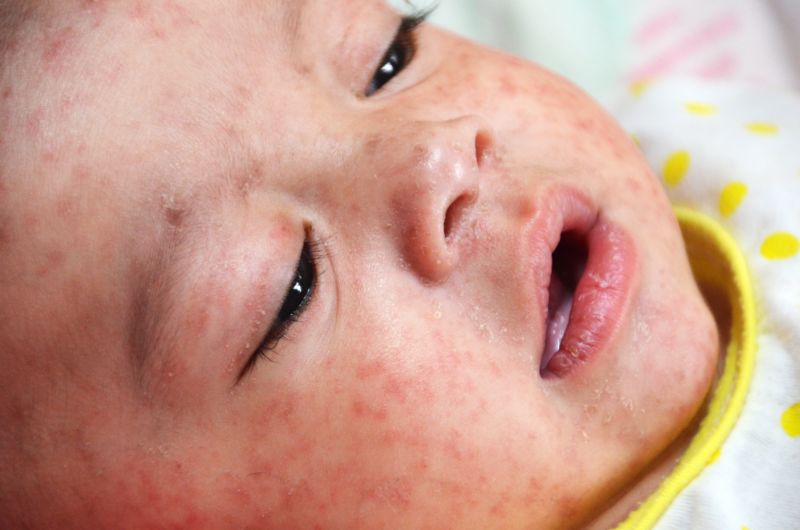
Enlarge / A baby with measles. CDC The Centers for Disease Control and Prevention is putting clinicians on alert about the growing r...

Popular Posts