Tuesday, September 29, 2020

Stock futures are flat amid positive virus treatment news, U.S. presidential debate - CNBC

U.S. stock futures declined on Tuesday night as traders digested the first U.S. presidential debate.
Positive data regarding a potential coronavirus treatment from Regeneron Pharmaceuticals kept the losses in check.
Dow Jones Industrial Average futures were down 101 points, or 0.4%. S&P 500 futures and Nasdaq 100 futures both lost 0.3%.
Futures rose slightly during the debate, but quickly gave up that ground as the debate ended. It wasn't clear whether the gyrations were related to the contentious comments being traded back and forth by the candidates. Traders are hoping that the start of the debate process will lead to a clear winner on Election Day and not a drawn-out electoral process that could hit the market.
"It was a long night and there's a lot that needs to be sorted out," said Daniel Deming, managing director at KKM Financial. "It became pretty apparent that this thing is not going to be over on Nov. 3 and I think the market is probably not too crazy about that."
"The short-term volatility pressures probably won't abate anytime soon after this debate. In a sense, it's creating even more uncertainty," Deming said.
President Donald Trump and Democratic nominee Joe Biden sparred on a number of issues, including their qualifications to manage the U.S. economy, the nomination of Amy Coney Barrett to the Supreme Court as well as the U.S.' handling of the coronavirus pandemic.
Biden came into the debate with an average lead of 6.1 percentage points in recent polls, according to RealClearPolitics. The former vice president was also the favorite to win the election in betting markets heading into the debate.
"Most people come away from it thinking it was an ugly experience," said Marc Chandler, chief market strategist at Bannockburn Global Forex. "I don't think it changed peoples' minds really."
Many market strategists have cited uncertainty around the election as a key headwind for the market before year-end with each outcome bringing its own risks and benefits. Some investors have raised concerns about a potential Biden win as they fear it could lead to higher corporate taxes and regulations. But at the same time, it could ease concerns about the trade war and lack of stimulus to bolster the economy in the wake of the coronavirus.
Investors are also worried about the potential the Nov. 3 result is too close to call and neither candidate concedes. That uncertainty could particularly weigh on the market.
"As far as the ballots are concerned, it's a disaster," Trump said on Tuesday night. "This is going to be a fraud like you've never seen."
"I think we're going to do well because people are really happy with the job we've done. But we might not know for months because these ballots are going to be all over" the place," he added.
Regeneron said after the close Tuesday its REGN-COV2 drug reduced viral levels and improved symptoms in non-hospitalized coronavirus patients. "The greatest treatment benefit was in patients who had not mounted their own effective immune response, suggesting that REGN-COV2 could provide a therapeutic substitute for the naturally-occurring immune response," Regeneron Chief Scientific Officer George D. Yancopoulos said in a statement.
The major averages snapped a three-day winning streak earlier in the day, with the Dow falling more than 100 points, or 0.5%. The S&P 500 also closed 0.5% lower and the Nasdaq Composite slid 0.3%. Those losses came amid concerns over a virus resurgence. New York City Mayor Bill de Blasio said the city's daily positive rate of coronavirus tests is back above 3% for the first time in months.
"Coronavirus infection rates are rising in Europe and the United States as children return to school," Terry Sandven, chief equity strategist at U.S. Bank Wealth Management, wrote in a note. "We expect the United States to continue its modest pace of economic improvement, though virus growth and a softer labor market are threats."
Subscribe to CNBC PRO for exclusive insights and analysis, and live business day programming from around the world.
"virus" - Google News
September 30, 2020 at 05:02AM
https://ift.tt/36jCKac
Stock futures are flat amid positive virus treatment news, U.S. presidential debate - CNBC
"virus" - Google News
https://ift.tt/2OagXru
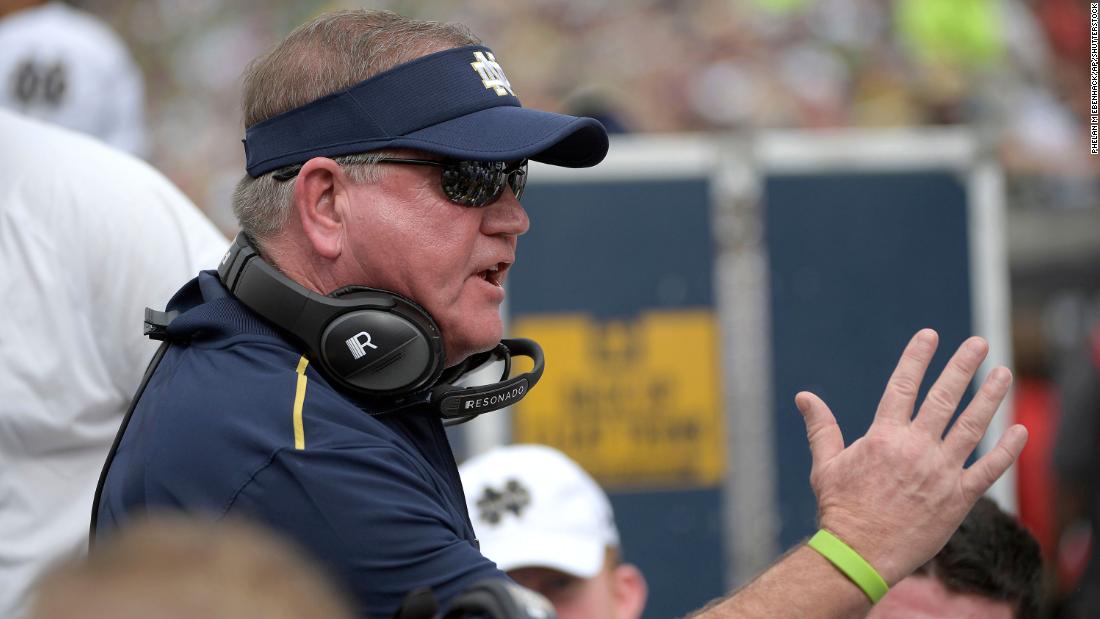
Notre Dame head coach Brian Kelly says Covid-19 'spread like wildfire' on his team - CNN
COVID-19 - Latest - Google News
September 30, 2020 at 06:48AM
https://ift.tt/3jh36No
Notre Dame head coach Brian Kelly says Covid-19 'spread like wildfire' on his team - CNN
COVID-19 - Latest - Google News
https://ift.tt/2VQ2gy8
Coronavirus Briefing: What Happened Today - The New York Times
This is the Coronavirus Briefing, an informed guide to the pandemic. Sign up here to get this newsletter in your inbox.

-
Trump administration officials pressured the C.D.C. this summer to play down the risks of sending children back to school.
-
Venezuelan doctors say the virus has killed at least 200 health workers across the country.
-
Prime Minister Benjamin Netanyahu said that Israel’s second national lockdown is likely to last at least a month and perhaps much longer.
-
Get the latest updates here, as well as maps and trackers for U.S. metro areas and vaccines in development.
Is the U.S. close to herd immunity?
Experts think that to reach herd immunity — the point at which the coronavirus can no longer spread widely — about 70 percent of a population must be immune, either through vaccination or surviving the infection. Some people, including President Trump, claim we’re nearly there.
Our colleague Donald G. McNeil Jr., who covers science, recently set out to determine how close the United States was to reaching that elusive milestone.
He asked three epidemic-modeling teams — the Prevention Policy Modeling Lab at Harvard’s T.H. Chan School of Public Health, the University of Minnesota’s Center for Infectious Disease Research and Policy, and the Covid-19 Projections website — to calculate what percentage of the country has been infected based on testing and death data from all 50 states.
Their responses were strikingly similar: They found that only 10 percent to 16 percent of Americans have had the virus, leaving up to 90 percent of the population vulnerable.
The numbers are in line with two other studies published last week. The Centers for Disease Control and Prevention, citing data from blood samples collected at labs across the country, said that less than 10 percent contained antibodies. And in a study published in The Lancet, Stanford University scientists examined almost 29,000 blood samples from dialysis centers and found antibodies in just over 9 percent of patients.
The theory that the U.S. may have already achieved herd immunity — and therefore we should get back to our regular lives — is circulating among conservative news programs and the Trump administration, and is gaining credence on Wall Street.
But these studies suggest herd immunity is still very far off.
“If we all took off our masks and went back into hanging out in bars and piling into the offices and subways, hundreds of thousands more of us would die,” Donald said.
Revisiting Sweden. Sweden became a lightning rod last spring when it refused to impose coronavirus lockdown measures. Now, as the country’s caseload remains surprisingly low, the question is whether it has found a sustainable balance, or whether the recent numbers are just a temporary anomaly.
An uptick of cases in New York City
After months of persistently driving down its virus numbers, New York City is witnessing a jump in virus cases — a troubling sign as the city takes some major steps toward resuming public life.
The city’s daily positivity rate, or the share of tests that come back positive, reached 3.25 percent on Tuesday, the highest it has been since June.
Officials are particularly concerned about eight neighborhoods in Brooklyn and Queens, including some predominantly Orthodox Jewish communities, which have accounted for about one-fourth of New York City’s new cases in the past two weeks, despite accounting for only about 7 percent of the city’s population.
The outbreak has emerged at a fraught, pivotal moment: Elementary schools reopened today, with about 300,000 children returning to classrooms for the first time since March, and indoor dining is set to resume tomorrow.
Mayor Bill de Blasio has said he would shut down the entire public school system if the city’s test positivity rate exceeded 3 percent over a seven-day rolling average. Based on the current trend, the city could reach that threshold quickly — and if schools are forced to close, it could take weeks for them to reopen, according to the city’s health officials.
Resurgences
-
Ontario, the most populous province in Canada, reported 700 new infections on Monday, its highest one-day total.
-
Kenya extended its nationwide curfew for two months. In an address to the nation, President Uhuru Kenyatta said bars and nightclubs could reopen but schools will remain closed.
-
The Netherlands tightened its coronavirus restrictions as cases quickly rose, warning that its most severe wave yet was likely to get worse.
Here’s a roundup of restrictions in all 50 states.
What else we’re following
-
The coronavirus will be one of the topics of tonight’s first presidential debate between President Trump and Joe Biden Here’s what to watch for.
-
People who are obese may struggle to mount a robust immune response to the coronavirus — and may respond poorly to a vaccine.
-
The U.S. government sent free rapid-test machines to 14,000 facilities. But they have come with unexpected costs, cumbersome reporting rules and questions about accuracy.
-
Congressional negotiators in the U.S. resumed talks over a coronavirus relief package in a final bid to revive stalled negotiations.
-
The Tennessee Titans suspended all in-person activities after three players and five members of the team’s personnel tested positive, the first such outbreak to hit an N.F.L. team since training camps began in late July.
-
When the virus hit a rural Kansas high school, one quarter of the student population was sent home to quarantine.
What you’re doing
Since our usual travel habit was eliminated by the virus, I went to the photo files and picked one photo each day to trigger happy memories of past trips and outings. At the end of the summer I put them into a short video and invited family and friends to share our “Covid Armchair Vacation.”
— Douglas Hartford, Arden Hills, Minn.
Let us know how you’re dealing with the pandemic. Send us a response here, and we may feature it in an upcoming newsletter.
Sign up here to get the briefing by email.
Email your thoughts to briefing@nytimes.com.
Health - Latest - Google News
September 30, 2020 at 05:00AM
https://ift.tt/2SaY9Kd
Coronavirus Briefing: What Happened Today - The New York Times
Health - Latest - Google News
https://ift.tt/2zrj9Ud
Investigational COVID-19 vaccine well-tolerated and generates immune response in older adults - National Institutes of Health
News Release
Tuesday, September 29, 2020
What
A Phase 1 trial of an investigational mRNA vaccine to prevent SARS-CoV-2 infection has shown that the vaccine is well-tolerated and generates a strong immune response in older adults. A report published today in the New England Journal of Medicine describes the findings from the study, which was supported by the National Institute of Allergy and Infectious Diseases (NIAID), part of the National Institutes of Health. SARS-CoV-2 is the virus that causes COVID-19 disease.
The experimental vaccine, mRNA-1273, was co-developed by researchers at NIAID and Moderna, Inc. of Cambridge, Massachusetts. The Phase 1 trial began on March 16, 2020, and was expanded to enroll older adults about one month later. Older adults are more vulnerable to complications of COVID-19 and are an important population for vaccination. Understanding how the vaccine affects older adults is a critical part of measuring its safety and efficacy.
The trial was conducted at Kaiser Permanente Washington Health Research Institute (KPWHRI) in Seattle, Emory University in Atlanta, and NIAID’s Vaccine Research Center (VRC) clinic at the NIH Clinical Center in Bethesda, Maryland. Julie Ledgerwood, D.O., deputy director and chief medical officer at the VRC, oversaw the study at the NIH site. The Coalition for Epidemic Preparedness Innovations (CEPI) supported the manufacturing of the vaccine candidate for this trial. This trial is supported by the Infectious Diseases Clinical Research Consortium (IDCRC) through NIAID.
In its expansion to include older adults, the trial enrolled 40 healthy volunteers: 20 adults ages 56 to 70 years, and 20 adults ages 71 years and older. Ten volunteers in each age group received a lower dose of the vaccine (25 µg), and 10 volunteers in each age group received a higher dose (100 µg). After approximately one month, volunteers then received a second dose of the same vaccine at the same dosage. Throughout the study, volunteers attended clinic visits to track their responses to the vaccine and assess safety.
Overall, the researchers found that the investigational vaccine was well-tolerated in this older age group. Although some volunteers experienced some transient adverse effects, including fever and fatigue after vaccination, the researchers found that they also exhibited a good immune response to the vaccine: the blood of vaccinated volunteers contained robust binding and neutralizing antibodies against SARS-CoV-2. Importantly, the immune response to the vaccine seen in older volunteers was comparable to that seen in younger age groups.
The study will continue to follow the older volunteers for approximately a year after second vaccination to monitor the long-term effects of the vaccine. According to the researchers, these Phase 1 trial results further support testing of the investigational vaccine in older adults in an ongoing large Phase 3 trial.
For more details on the trial, please see NIAID’s March 16 press release, NIAID’s March 27 statement, or visit ClinicalTrials.gov and search identifier NCT04283461.
Article
Anderson et al. Safety and immunogenicity of SARS-CoV-2 mRNA-1273 vaccine in older adults. New England Journal of Medicine DOI: 10.1056/NEJMoa2028436 (2020).
Who
Dr. John Beigel, associate director for Clinical Research in NIAID’s Division of Microbiology and Infectious Diseases, and Dr. Barney Graham, deputy director of NIAID’s Vaccine Research Center, are available for comment.
NIAID conducts and supports research—at NIH, throughout the United States, and worldwide—to study the causes of infectious and immune-mediated diseases, and to develop better means of preventing, diagnosing and treating these illnesses. News releases, fact sheets and other NIAID-related materials are available on the NIAID website.
About the National Institutes of Health (NIH): NIH, the nation's medical research agency, includes 27 Institutes and Centers and is a component of the U.S. Department of Health and Human Services. NIH is the primary federal agency conducting and supporting basic, clinical, and translational medical research, and is investigating the causes, treatments, and cures for both common and rare diseases. For more information about NIH and its programs, visit www.nih.gov.
NIH…Turning Discovery Into Health®
Health - Latest - Google News
September 30, 2020 at 03:24AM
https://ift.tt/36eR2ZD
Investigational COVID-19 vaccine well-tolerated and generates immune response in older adults - National Institutes of Health
Health - Latest - Google News
https://ift.tt/2zrj9Ud
Human cases of West Nile Virus for 2020 reported to DHHS - KOLN

LINCOLN, Neb. (KOLN) -Three people have recently tested positive for West Nile virus according to the Nebraska Department of Health and Human Services. Each of the following health departments have reported one human case - Three Rivers Health Department which covers Dodge, Saunders and Washington counties, Lincoln-Lancaster County Health Department and Douglas County Health Department.
“West Nile virus is a mild illness for most, but can be serious for others so it’s good to be in the habit of protecting yourself against mosquitos,” said Dr. Tom Safranek, Special Assistant to the CEO. “These are the first human West Nile cases so far this season. Our surveillance data shows that West Nile virus isn’t circulating widely in the mosquito population, but with Nebraskans taking advantage of mild weather to be outdoors basic prevention is still important.”
Preventive tips:
- Use mosquito repellent when spending time outside. Repellents containing DEET, picaridin, IR3535, 2-unecanone, and some lemon eucalyptus and para-menthane-diol products provide longer-lasting protection.
- Wear long-sleeved shirts, pants and socks when outside.
- Limit time outdoors when mosquitoes are most active – at dusk and dawn.
- Drain areas of standing water, where mosquitos lay eggs.
West Nile virus is transmitted through mosquito bites. Mosquitos acquire it by feeding on infected birds and pass it to people and animals. Last year there were 28 human cases in Nebraska and one death.
Most people with West Nile virus will have no symptoms or only mild flu-like symptoms such as a fever and headache. Those over 50 and anyone with weakened immune systems are at increased risk for a more severe infection.
Severe infections typically occur five to 15 days after exposure and can present as rapid onset of a high fever, body aches, vomiting, fatigue, neck stiffness, disorientation, and tremors. Symptoms consistent with a more severe infection should be reported to a doctor.
DHHS began annual West Nile virus surveillance in June. Subscribe to the DHHS West Nile virus webpage for the latest updates - www.dhhs.ne.gov/wnv
Copyright 2020 KOLN. All rights reserved.
"virus" - Google News
September 30, 2020 at 04:07AM
https://ift.tt/30k5n2X
Human cases of West Nile Virus for 2020 reported to DHHS - KOLN
"virus" - Google News
https://ift.tt/2OagXru
Medical historian compares the coronavirus to the 1918 flu pandemic: Both were highly political - CNBC
In less than nine months, the coronavirus has quickly spread to more than 33 million people across the globe, killing more than 1 million and becoming the third-leading cause of death in the United States, behind only heart disease and cancer.
There is nothing in recent history that compares to a contagious crisis of this magnitude, according to historians who study infectious diseases and disasters. The H1N1 flu pandemic in 2009 infected an estimated 60.8 million people in its first year, but the virus wasn't nearly as severe as Covid-19, killing between 151,700 and 575,400 worldwide, according to the Centers for Disease Control and Prevention. MERS, another coronavirus that emerged in 2012, was much deadlier than Covid but significantly less infectious with only 2,494 reported cases.
Covid-19 is "a scary virus and definitely one that you do not want to get," said Howard Markel, a physician and medical historian at the University of Michigan. "It's a very dangerous, very crafty, stealthy virus."
The 1918 virus was also a "novel" virus, meaning it was brand new. Like Covid-19, no one had any immunity to it, and it was highly infectious, spreading through respiratory droplets that pass when an infected person coughed or sneezed.
Different symptoms
The viruses attacked the body in different ways. Covid-19 can be mild, sometimes causing no symptoms whatsoever, or severe — putting patients in hospitals and on ventilators for weeks and leaving them with lingering effects of fatigue and coughing for months. Covid-19 can also be unpredictable, stressing virtually every system in the body, including the heart, kidneys and brain.
The 1918 flu pandemic came in three waves, occurring in the spring of 1918, the fall of 1918; and the winter and spring of 1919, according to the CDC.
The 1918 flu killed 50 million people worldwide from 1918 through 1919, including 675,000 Americans, according to the CDC. It is estimated that one-third of the world's population became infected with the virus.
The first wave of the 1918 flu came with the usual flu symptoms: fever, nausea, body aches and diarrhea. The second wave was dramatically worse. It could set in suddenly, killing patients within days or even hours after symptoms began. The virus would cause their lungs to fill with fluid and the lack of oxygen would make their skin turn blue until they suffocated.
There also wasn't a vaccine for the 1918 flu, and, like Covid-19, the crisis was highly politicized in the United States.
"We were getting involved in World War I and it was a very patriotic effort. You know, the war to end all wars," Markel said. "They were sending off young men in parades. Women were left behind and starting Red Cross chapters and making bandages and all sorts of things, sending the men off in a proper way."
The pandemic became mixed in with the patriotic fervor, he said.
Like today, schools and businesses were closed and infected people were quarantined, according to influenzaarchive.org.
1918 mask mandates
"You told people to wash your hands, don't cough on people, stay at home, stay away from other people," he said. "It was the patriotic thing to do to not cough on people or stay home if you were sick."
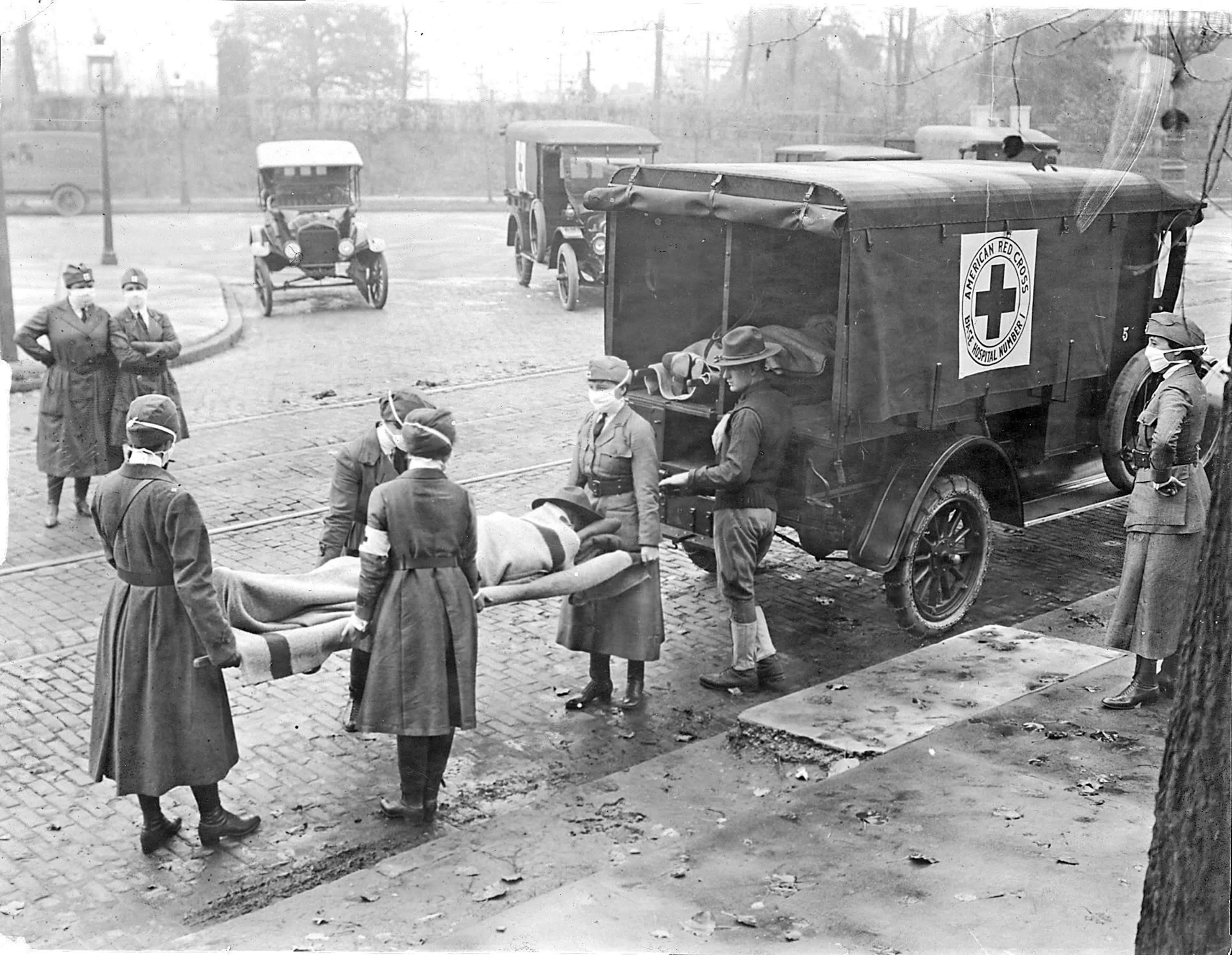
But the thing that really drew public backlash were mask recommendations. As it turns out, resistance to wearing the face coverings isn't new. People during the 1918 pandemic called them dirt traps and some clipped holes so they could smoke cigars.
In Europe, the Italian Supreme Command asked residents not to fail their cities by not wearing a mask. Several U.S. cities implemented mandates, describing them as a symbol of "wartime patriotism." In San Francisco, Mayor James Rolph said, "conscience, patriotism and self-protection demand immediate and rigid compliance," according to influenzaarchive.org. But some people refused to comply or take them seriously, Markel said.
San Francisco residents considered masks a nuisance while others harbored resentment for being forced to wear them, he said. Some of them were arrested.
"One woman, a downtown attorney, argued to Mayor Rolph that the mask ordinance was 'absolutely unconstitutional' because it was not legally enacted, and that as a result, every police officer who had arrested a mask scofflaw was personally liable," according to influenzaarchive.org.
Pandemic news
The news in 1918 didn't flow as quickly as it does today with the internet and smartphones, but it also couldn't be manipulated as much as today and newspapers published at least six or seven editions a day back then, Markel said. State public health departments also held regular public press briefings, he added.
"If you wanted to partake on it, it was there," he said.
Some newspapers referred to the virus as the "Spanish flu," even though the first known case was reported at an army base in Kansas. Spain remained neutral throughout World War I and reported on the virus freely, giving the impression that the outbreak was bad there. Eventually, newspapers would just refer to it as "influenza" or the "influenza epidemic," Markel said.
Woodrow Wilson vs Donald Trump
Additionally, some reports have suggested that then-President Woodrow Wilson downplayed the virus, but that is a "wrong and a false trope of popular history," Markel said. Wilson, who would later contract the virus, was organizing and commanding the U.S. effort in World War I and once the war ended, he sailed for Paris, where he stayed until April of 1919 organizing a peace treaty and the League of Nations, Markel said.
"The federal government played a very small role in American public health during that era. It was primarily a city and state role and those agencies were hardly downplaying it," he said.
Unlike today, there was no CDC or national public health department. The Food and Drug Administration existed but consisted of a very small group of men. Additionally, there were no antibiotics, intensive care units, ventilators, IV fluids or vaccines. "You got a bed or maybe nursing care," Markel said.
But there was an epidemiologist much like Dr. Anthony Fauci, director of the National Institute of Allergy and Infectious Diseases, who withstood criticism for publicly pressing for safety protocols, according to Forbes.
"At the center of public health efforts in both states was a practical, plainspoken, bespectacled scientist: Dr. Thomas Dyer Tuttle, who became a powerful, if polarizing, figure in the fight against the Spanish flu," according to Forbes.
Scientists hadn't even seen a virus under the microscope at that point, said Graham Mooney, a medical historian at Johns Hopkins University School of Medicine. They didn't have the technology and they knew almost nothing of virology, which was considered a nascent science because viruses are so small, he said. In fact, some scientists thought the 1918 virus was caused by a bacteria called Haemophilus influenzae, he said.
"Now we have a much greater capacity to create a preventative mechanism through immunizations and vaccinations," Mooney said.
Massive death toll
The 1918 virus also tended to kill differently than Covid-19, Mooney and Markel noted. With World War I, there was a massive movement of men across all of America and Europe. While the coronavirus can be especially severe for the elderly and those with underlying health conditions, the 1918 virus was unusual in that it killed many young adults, Markel said.
"Influenza generally has a U shaped mortality curve, meaning it looks like a U, but the tops of the U are the most deadly," Markel said. "But in 1918 it was a W shaped mortality curve and that upside-down part of the W, the V, was young people between ages 18 and 40 dying like flies. That was odd. That was not typical for previous flu pandemics or subsequent ones."
It's also important to consider population when talking about outbreaks or disasters, said Samantha Montano of the Massachusetts Maritime Academy, who studies disasters. In 1918, the world population was much smaller with an estimated 1.8 billion people. Today, there are nearly 8 billion on the planet.
Mooney echoed those remarks, saying, "We're talking about a global population that is sort of smaller than it is now." He said the death toll from 1918 virus likely had a great impact on the workforce who were unable to work from home or remotely like we can today.
"You end up having major structural, economic and social readjustments when you have such a massive death toll like that," he said. "We have social welfare networks ... people travel around the globe. We have different societies and economies."
Medical historians say the U.S. can learn from the 1918 virus.
"It is utterly earth-shaking what we've done in the last century alone," Markel said.
Health - Latest - Google News
September 29, 2020 at 07:41AM
https://ift.tt/3icxBD1
Medical historian compares the coronavirus to the 1918 flu pandemic: Both were highly political - CNBC
Health - Latest - Google News
https://ift.tt/2zrj9Ud
Featured Post
Measles is “growing global threat,” CDC tells doctors in alert message - Ars Technica
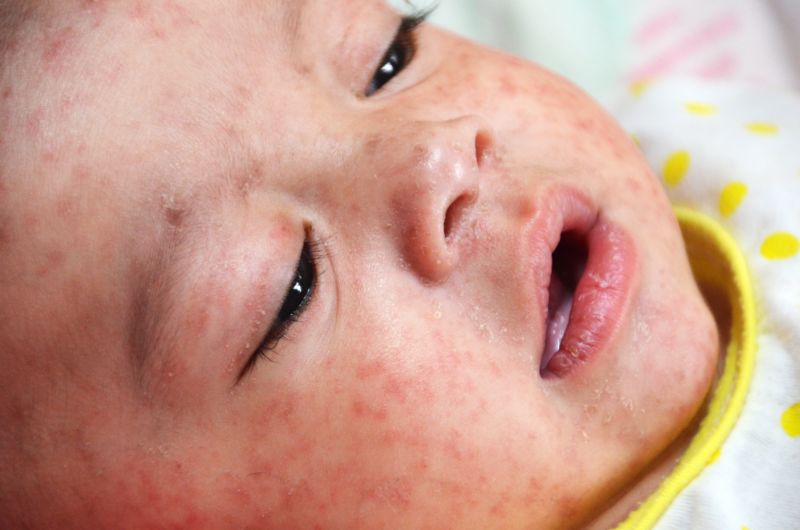
Enlarge / A baby with measles. CDC The Centers for Disease Control and Prevention is putting clinicians on alert about the growing r...
Popular Posts
-
Enlarge / A baby with measles. CDC The Centers for Disease Control and Prevention is putting clinicians on alert about the growing r...
-
[unable to retrieve full-text content] Global Pandemic Could Last 7 Years at Current Covid Vaccination Rates Bloomberg Quicktake: Now ...
-
With cases swelling in 49 states and hospitalizations on the rise, the U.S. is seeing a “pandemic of the unvaccinated” in parts of the c...

