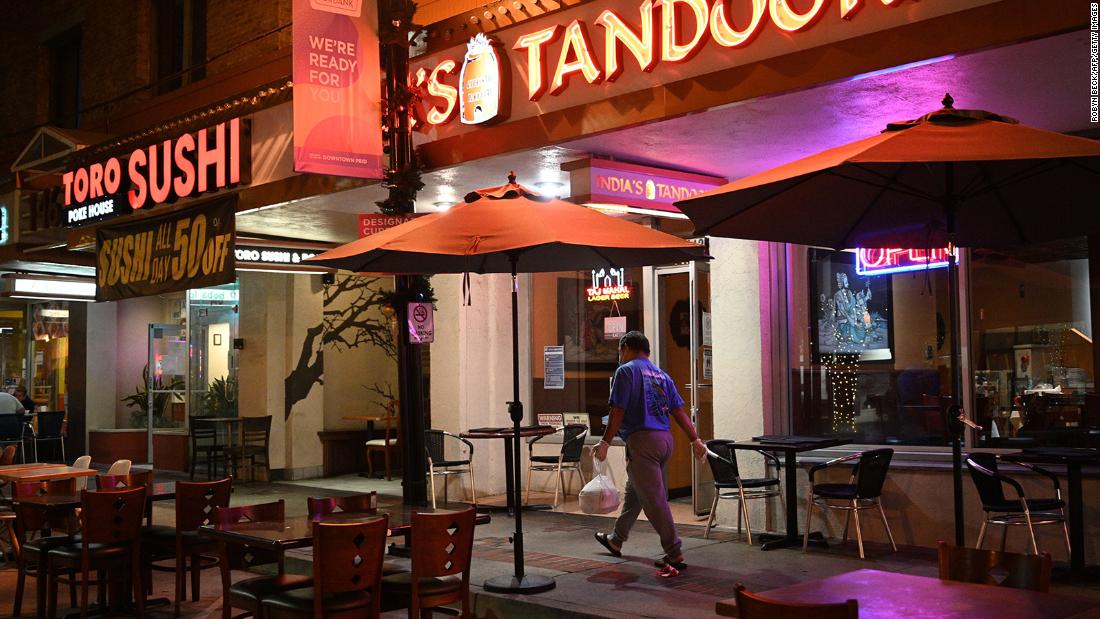
The ban will last three weeks, starting Monday and ending December 20.
All 10 million residents are asked to stay home as much as possible and wear face masks when outside -- even when exercising at the beach and parks, said the Los Angeles County Department of Public Health, which issued the order last week.
All playgrounds and cardrooms will be closed, but beaches, trails and parks will remain open to groups who live in the same household.
The order also reduces the maximum occupancy for essential businesses to 35%, and for non-essential businesses, personal care services, and libraries to 20%.
Businesses operating outdoors, including fitness centers, zoos, botanical gardens and batting cages, are reduced to a maximum of 50% capacity.
The order exempts outdoor church services and protests, which are constitutionally protected rights, the county said.
But the Los Angeles County Sheriff's Department said it will not enforce the new stay-at-home order, instead relying on voluntary compliance.
"Since the first Stay at Home Order was issued in March of this year, we have focused on education and voluntary compliance, with enforcement measures being an extreme last resort," the sheriff's department said in a statement to CNN.
"We trust in the community and rely on people to assess risk and take precautions as appropriate."
Los Angeles County, the most populous county in the US, recently reported a record number of new Covid-19 infections and the most deaths in months.
The county reported 395,843 confirmed cases of Covid-19 and 7,639 deaths as of Sunday. The county's 7-day average of test positivity rate is 6.9%.
This animated video explains how Pfizer and Moderna's genetic vaccine works against COVID-19.
Of 196 COVID-19 cases so far in its huge U.S. study, 185 were trial participants who received the placebo and 11 who got the real vaccine. The only people who got severely ill — 30 participants, including one who died — had received dummy shots, said Dr. Tal Zaks, the Cambridge, Massachusetts, company's chief medical officer.
When he learned the results, “I allowed myself to cry for the first time,” Zaks told The Associated Press. “We have already, just in the trial, have already saved lives. Just imagine the impact then multiplied to the people who can get this vaccine.”
Moderna said the shots’ effectiveness and a good safety record so far — with only temporary, flu-like side effects — mean they meet requirements set by the U.S. Food and Drug Administration for emergency use before the final-stage testing is complete. The European Medicines Agency, Europe’s version of FDA, has signaled it also is open to faster, emergency clearance.
WHAT COMES NEXT
The FDA has pledged that before it decides to roll out any COVID-19 vaccines, its scientific advisers will publicly debate whether there’s enough evidence behind each candidate.
First up on Dec. 10, Pfizer and BioNTech will present data suggesting their vaccine candidate is 95% effective. Moderna said its turn at this “science court” is expected exactly a week later, on Dec. 17.
RATIONING INITIAL DOSES
If the FDA allows emergency use, Moderna expects to have 20 million doses ready for the U.S. by year’s end. Recipients will need two doses, so that’s enough for 10 million people.
Pfizer expects to have 50 million doses globally in December. Half of them — or enough for 12.5 million people — are earmarked for the U.S.
This week, a different panel of U.S. experts, established by the Centers for Disease Control and Prevention, will meet to decide how initial supplies will be given out. They're expected to reserve scarce first doses for health care workers and, if the shots work well enough in the frail elderly, for residents of long-term care facilities. As more vaccine gradually becomes available in coming months, other essential workers and people at highest risk from the coronavirus would get in line. But enough for the general population isn't expected until at least spring.
Outside the U.S., Zaks said significant supplies from Moderna would be available later, “in the first quarter” of next year.
“Obviously we are doing everything in our power to increase the capacity and accelerate the timelines,” he said.
Both Moderna's and Pfizer's vaccines are made with the same technology, using a piece of genetic code for the “spike” protein that studs the virus. That messenger RNA, or mRNA, instructs the body to make some harmless spike protein, training immune cells to recognize it if the real virus eventually comes along.
ASTRAZENECA CONFUSION
AstraZeneca last week announced confusing early results of its vaccine candidate from research in Britain and Brazil
That vaccine appears 62% effective when tested as originally intended, with recipients given two full doses. But because of a manufacturing error, a small number of volunteers got a lower first dose — and AstraZeneca said in that group, the vaccine appeared to be 90% effective.
Experts say it’s unclear why the lower-dose approach would work better and that it may just be a statistical quirk.
A larger U.S. study of the AstraZeneca candidate still is underway that should eventually give the FDA a better picture of how well it works. The FDA has said any COVID-19 vaccine would have to be at least 50% effective.
Meanwhile Britain’s government will have to decide whether its U.K. data is sufficient for an early rollout there.
STILL IN THE PIPELINE
Johnson & Johnson also is in final-stage testing in the U.S. and several other countries to see if its vaccine candidate could work with just one dose.
Both the J&J and AstraZeneca vaccines work by using harmless cold viruses to carry the spike protein gene into the body and prime the immune system.
The different technologies have ramifications for how easily different vaccines could be distributed globally. The AstraZeneca shots won't require freezer storage like the Pfizer and Moderna vaccines.
Candidates made with still other technologies are in late-stage testing, too. Another U.S. company, Novavax Inc., announced Monday that it has finished enrolling 15,000 people in a late-stage study in Britain and plans to begin recruiting even more volunteers for final testing in the U.S. and Mexico “in the coming weeks.”
Vaccines made by three Chinese companies and a Russian candidate also are being tested in thousands of people in countries around the world.
The drugmaker Moderna said it would apply on Monday to the Food and Drug Administration to authorize its coronavirus vaccine for emergency use.
The first injections may be given as early as Dec. 21 if the process goes smoothly and approval is granted, Stéphane Bancel, the company’s chief executive, said in an interview.
Moderna’s application is based on data that it also announced on Monday, showing that its vaccine is 94.1 percent effective, and that its study of 30,000 people has met the scientific criteria needed to determine whether the vaccine works. The finding from the complete set of data is in line with an analysis of earlier data released on Nov. 16 that found the vaccine to be 94.5 percent effective.
The new data also showed that the vaccine was 100 percent effective at preventing severe disease from the coronavirus. The product was developed in collaboration with government researchers from the Vaccine Research Center at the National Institute of Allergy and Infectious Diseases.
Mr. Bancel said the company was “on track” to produce 20 million doses by the end of December, and 500 million to a billion in 2021. Each person requires two doses, administered a month apart, so 20 million doses will be enough for 10 million people.
Moderna is the second vaccine maker to apply for emergency use authorization; Pfizer submitted its application on Nov. 20. Pfizer has said it can produce up to 50 million doses this year, with about half going to the United States. Its vaccine also requires two doses per person.
The hopeful news arrives at a particularly grim moment in the U.S. health crisis. Coronavirus cases have surged and overwhelmed hospitals in some regions, and health officials have warned that the numbers may grow even worse in the coming weeks because of Thanksgiving travel and gatherings. In November alone, there have been more than four million new cases and 25,500 deaths in the United States.
One of those is made by AstraZeneca, which announced positive but puzzling preliminary results on Nov. 23: Its vaccine was 90 percent effective in people who received a half dose and then a full one, but 62 percent effective in those who received two full doses. Researchers are waiting for more data.
Moderna’s application for emergency use authorization will include data from its Phase 3 study of 30,000 people. The application, several hundred pages long, will also include several thousand pages of additional data.
F.D.A. scientists will examine the information, and the application is likely to undergo a final review on Dec. 17 by a panel of expert advisers to the agency, Mr. Bancel said, adding that he expected the advisers to make a decision within 24 to 72 hours. The F.D.A. usually follows the recommendations of its advisory panels.
Officials at Operation Warp Speed, the government’s program to accelerate vaccine development, have said vaccinations could begin within 24 hours after the F.D.A. grants authorization.
Mr. Bancel said that Moderna had not yet begun shipping vaccines across the country, and would not do so until the emergency authorization is granted.
The government has arranged to buy vaccines from both Moderna and Pfizer and to provide it to the public free of charge. Moderna has received a commitment of $955 million from the U.S. government’s Biomedical Advanced Research and Development Authority for research and development of its vaccine, and the United States has committed up to $1.525 billion to buy 100 million doses.
The Road to a Coronavirus Vaccine
Words to Know About Vaccines
Confused by the all technical terms used to describe how vaccines work and are investigated? Let us help:
Adverse event: A health problem that crops up in volunteers in a clinical trial of a vaccine or a drug. An adverse event isn’t always caused by the treatment tested in the trial.
Antibody: A protein produced by the immune system that can attach to a pathogen such as the coronavirus and stop it from infecting cells.
Approval, licensure and emergency use authorization: Drugs, vaccines and medical devices cannot be sold in the United States without gaining approval from the Food and Drug Administration, also known as licensure. After a company submits the results of clinical trials to the F.D.A. for consideration, the agency decides whether the product is safe and effective, a process that generally takes many months. If the country is facing an emergency — like a pandemic — a company may apply instead for an emergency use authorization, which can be granted considerably faster.
Background rate: How often a health problem, known as an adverse event, arises in the general population. To determine if a vaccine or a drug is safe, researchers compare the rate of adverse events in a trial to the background rate.
Efficacy: A measurement of how effective a treatment was in a clinical trial. To test a coronavirus vaccine, for instance, researchers compare how many people in the vaccinated and placebo groups get Covid-19. The real-world effectiveness of a vaccine may turn out to be different from its efficacy in a trial.
Phase 1, 2, and 3 trials: Clinical trials typically take place in three stages. Phase 1 trials usually involve a few dozen people and are designed to observe whether a vaccine or drug is safe. Phase 2 trials, involving hundreds of people, allow researchers to try out different doses and gather more measurements about the vaccine’s effects on the immune system. Phase 3 trials, involving thousands or tens of thousands of volunteers, determine the safety and efficacy of the vaccine or drug by waiting to see how many people are protected from the disease it’s designed to fight.
Placebo: A substance that has no therapeutic effect, often used in a clinical trial. To see if a vaccine can prevent Covid-19, for example, researchers may inject the vaccine into half of their volunteers, while the other half get a placebo of salt water. They can then compare how many people in each group get infected.
Post-market surveillance: The monitoring that takes place after a vaccine or drug has been approved and is regularly prescribed by doctors. This surveillance typically confirms that the treatment is safe. On rare occasions, it detects side effects in certain groups of people that were missed during clinical trials.
Preclinical research: Studies that take place before the start of a clinical trial, typically involving experiments where a treatment is tested on cells or in animals.
Viral vector vaccines: A type of vaccine that uses a harmless virus to chauffeur immune-system-stimulating ingredients into the human body. Viral vectors are used in several experimental Covid-19 vaccines, including those developed by AstraZeneca and Johnson & Johnson. Both of these companies are using a common cold virus called an adenovirus as their vector. The adenovirus carries coronavirus genes.
Trial protocol: A series of procedures to be carried out during a clinical trial.
Both Moderna’s and Pfizer’s vaccines use a synthetic form of genetic material from the coronavirus called messenger RNA, or mRNA, to program a person’s cells to make many copies of a part of the virus. That viral fragment sets off alarms in the immune system and trains it to recognize and attack if the real virus tries to invade.
No mRNA vaccine has reached the market before, and the candidates from Pfizer and Moderna have faced considerable skepticism from scientists and a wary public.
But the strong results from both vaccines have begun to quash the doubts.
So far, neither vaccine has had serious side effects, but many recipients have had headaches, mild fevers, fatigue, joint and muscle aches and sore arms for a day or two.
Of the 30,000 people in the Moderna study, half were vaccinated and half received placebo shots of salt water; neither the participants nor their doctors knew who got what. Then, researchers monitored the participants to see who contracted the coronavirus, and watched for side effects.
To determine statistically whether the vaccine was effective, a total of 151 cases of Covid-19 were needed.
Because the coronavirus has been surging in the United States, Moderna wound up with 196 cases — 185 in the placebo group, and 11 in the vaccinated group, meaning that the vaccine was 94.1 percent effective at preventing Covid-19.
Thirty participants had severe cases, all in the placebo group. One died.
Mr. Bancel said he considered the statistics about prevention of severe disease the most important data from the study.
“This is why I think this vaccine is going to be a game-changer,” he said. The vaccine will reduce hospitalizations and deaths, he added, “and I hope get this country back to its pre-pandemic state.”
Moderna said it was also seeking authorization to market its vaccine in Europe, Canada, Britain, Israel and Singapore.
Swab tests on more than 105,000 people showed that Covid-19 infections are declining in England, according to an interim report from the Real-time Assessment of Community Transmission (REACT) program.
The report includes results from home coronavirus tests taken between November 13 and 24, and shows that "an estimated 0.96% of England's population has the virus, or around 1 in 100 people."
"This is roughly a 30% drop in the number of infections compared with previous findings, where more than 1 in 80 or 1.3% of people had the virus as of 2nd November," according to the researchers from Imperial College London and Ipsos MORI.
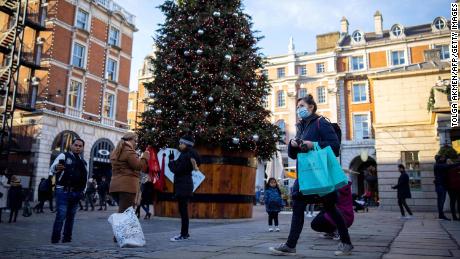
The four-week national lockdown in England, which saw non-essential businesses close and residents told not to mix with other households, began on November 5 and will end on Wednesday.
It came after the UK experienced a second wave of infection, which particularly affected regions in the north of England. The government introduced a localized system for the country, under which regions where infections were high were placed under tighter restrictions than other areas. England will return to a tiered system on Wednesday.
"We're seeing a fall in infections at the national level and in particular across regions that were previously worst affected. These trends suggest that the tiered approach helped to curb infections in these areas and that lockdown has added to this effect," said Paul Elliott, the director of the program at Imperial.
Cases dropped across most of England, most dramatically in the country's previous hotspots in the North, where they fell by over 50%, the researchers found. There was very little change in London and the East Midlands region, but the rapid growth of the epidemic seen in the capital and the South in mid- to late-October was no longer apparent.
The West Midlands now has the highest number of infections at 1.55% of the population, according to the report.
The research showed the R-number (or reproduction number, which indicates how many other people each infected person passes the virus onto) has fallen below 1 to an estimated at 0.88, "meaning that the country's epidemic is currently shrinking rather than growing," according to the researchers.
London had the country's highest R-number at 0.95, while the lowest were found in northwest and northeast England, at 0.76 and 0.78, respectively.
Infections were down among most age groups except those of school age, where there was an increase, the researchers said. Schools remained open during the second national lockdown, while they were closed in the first lockdown in spring.Fewer children appear to become seriously ill with the virus.
The researchers also drew attention to the fact "the virus is having an uneven impact" on people, with health workers, people living in large households and minority ethnic individuals all having a higher risk of infection.
There was also a link with deprivation, the report said and people from the poorest areas had the highest number of infections. The researchers said this suggested that social inequalities could be contributing to the virus spreading more in certain communities.
Other scientists have raised questions about how asymptomatic Covid-19 cases may affect the virus case count.
"In the most recent [REACT] survey approximately 40% of those who tested positive did not have symptoms at the time the sample was taken," Mark Woolhouse, an epidemiologist at the University of Edinburgh, told the UK's Science Media Centre.
He noted that this was about 1 in 200 people, which would equate to more than 250,000 cases across England.
Woolhouse said the results supported the UK government's aim "to make mass testing as widely available as possible so as to find large numbers of people who may be infectious without knowing it."
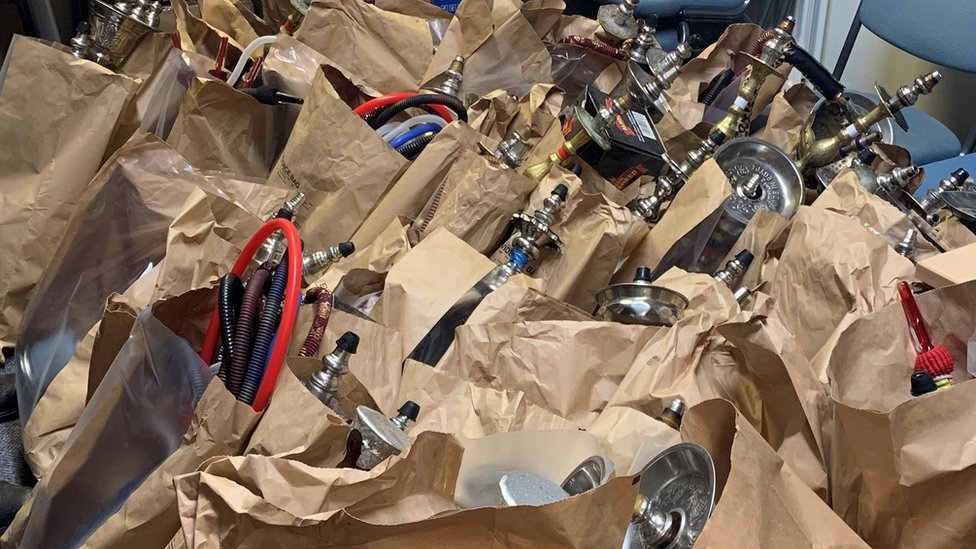
Insp John Mallows, from the force's city centre neighbourhood team, said: "We want the public to know that police and local authorities will take action to address Covid-19 breaches and the warrant is one example of our partnership working to tackle repeated issues.
"Individuals who seek to ignore the rules and put both theirs and other lives at risk will face enforcement action."
Health - Latest - Google News
November 30, 2020 at 01:54PM
https://ift.tt/37mORSy
With more restrictions to take effect, some L.A. County restaurant holdouts defy COVID-19 shutdown orders - KTLA Los Angeles
Health - Latest - Google News
https://ift.tt/2zrj9Ud