Rechercher dans ce blog

Wednesday, March 31, 2021

Team describes virus-origin study as just a start - Arkansas Online - Arkansas Online

GENEVA -- An international team behind a long-awaited study with Chinese colleagues about the possible origins of covid-19 called it a "first start" on Tuesday, while the United States and allies expressed concerns about the findings and China trumpeted its cooperation.

Team leader Peter Ben Embarek of the World Health Organization presented the team's first-phase look into the possible origins of the coronavirus, which has killed more than 2.8 million people and pummeled economies since it first turned up in China more than a year ago.

[Video not showing up above? Click here to watch » https://www.youtube.com/watch?v=wz7DKrj6OxA]

The report, formally published on Tuesday, said transmission of the virus from bats to humans through another animal was the most likely scenario and that a lab leak was "extremely unlikely," but all hypotheses remain open.

After the report's publication, the U.S. and more than a dozen other countries expressed concerns about the study, pointing to delays and a lack of access to samples and data -- without finger-pointing at Beijing directly. China responded by reiterating its criticism of efforts to "politicize" the issue.

White House press secretary Jen Psaki said the Biden administration was still reviewing the WHO report, but she added that "it lacks crucial data, information. ... It lacks access. It lacks transparency." She said the study did not rise to the level of the impact that the pandemic has had on the world.

"That's why we also have called for additional forward-looking steps," she said in a briefing with reporters. "It doesn't lead us to any closer [to an] understanding or greater knowledge than we had six to nine months ago about the origin."

Separately, in what it called a joint statement by 14 countries, the State Department urged "momentum" for a second-phase look by experts and pointed to the need for further animal studies "to find the means of introduction into humans."

The countries expressed support for the WHO's experts and staff, citing their "tireless" work toward ending the pandemic and understanding its origins to help prevent a future one. But they said the study had been "significantly delayed and lacked access to complete, original data and samples."

Psaki said China has "not been transparent" with the U.N. health agency.

Critics of China's government say it took too long to allow in the team members: Their roughly four-week visit to China in January and February came more than a year after the coronavirus outbreak was first noticed in the city of Wuhan.

Ahead of the report's release, senior U.S. officials, including Secretary of State Antony Blinken, expressed concern about its content and framing, saying Beijing "helped to write it."

The European Union, in a separate statement, echoed concerns about the late start to the study, the delayed deployment of the expert team, and the limited availability of samples and data, but it called the report "a helpful first step."

A statement on the Chinese Foreign Ministry's website after the release pointed to China's cooperation with the WHO and said the Chinese side "offered necessary facilitation for the team's work, fully demonstrating its openness, transparency and responsible attitude."

It repeated China's frequent criticism of efforts to politicize the issue, saying that it will "jeopardize anti-pandemic cooperation, and cost more lives." It also reiterated the Chinese government's belief that the study of the pandemic's origins "should be conducted in multiple countries and localities."

FUTURE STUDIES

World Health Organization Director-General Tedros Adhanom Ghebreyesus said Tuesday that he expected "future collaborative studies to include more timely and comprehensive data sharing" and pointed to the need for future research, including possible studies at laboratories in Wuhan.

Tedros, who has largely steered clear of calling out China, said team members raised concerns to him about access to raw epidemiological data needed for the report.

"The team reports that the first detected case had symptom onset on the 8th of December, 2019. But to understand the earliest cases, scientists would benefit from full access to data, including biological samples from at least September 2019," he said at the briefing. "I expect future collaborative studies to include more timely and comprehensive data sharing."

Ben Embarek said the team members faced political pressure from "all sides" but insisted: "We were never pressured to remove critical elements in our report." He also pointed to "privacy" issues in China that prevented sharing of some data, saying similar restrictions exist in many countries.

Joined by several team members for the news conference, Ben Embarek said that "where we did not have full access to all the raw data we wanted, that has been put as a recommendation for the future studies."

"This is only a first start -- we've only scratched the surface of this very complex set of studies that need to be conducted," Ben Embarek said. "We have pointed to many additional studies that should be conducted from now on."

"This is a work in progress," he added, "and we all have to be patient."

UNLIKELY HYPOTHESIS

Ben Embarek said it was difficult to know when, if at all, the precise origin of the pandemic will come to light. While the team members believe one hypothesis -- that the virus could have leaked from a laboratory -- was not likely, it was "not impossible" either, he said.

"We haven't seen or been able to hear or see or look at anything that would warrant different conclusions from our side," he said.

But in its report, the team concluded that it is extremely unlikely that the virus leaked from a lab -- a theory that many scientists dismiss for lack of evidence but that others are not ready to rule out, especially without additional proof of the means of transmission.

The visit to the Wuhan Institute of Virology, a facility known for working with bat coronaviruses, lasted hours, according to scientists on the trip.

They got a tour of the facility in the presence of staff members and officials, heard about the lab's safety protocols and were told that the lab was not working with viruses close to SARS-CoV-2, as the novel coronavirus that causes covid-19 is officially known.

Tedros echoed the teams findings, noting the team's access to the lab and its conclusion that a lab leak was extremely unlikely.

"I do not believe that this assessment was extensive enough," he said. "Further data and studies will be needed to reach more robust conclusions."

Information for this article was contributed by Emily Rauhala of The Washington Post and by Jamey Keaten and Josh Boak of The Associated Press.

Let's block ads! (Why?)


"virus" - Google News
March 31, 2021 at 04:37PM
https://ift.tt/2PcVp1f

Team describes virus-origin study as just a start - Arkansas Online - Arkansas Online
"virus" - Google News
https://ift.tt/2OagXru

‘It Felt Like Deception’: An Elite NYC Hospital Charges Huge Virus Test Fees - The New York Times

Insurers are stuck with the big bills from Lenox Hill, but the public ultimately pays through higher premiums.

The Lenox Hill Greenwich Village emergency department, where patients have been charged extraordinarily high prices for coronavirus tests. This photo was taken in mid-March; the blue parts of the signs advertising coronavirus testing have since been removed.
Steven Molina Contreras for The New York Times

Lenox Hill Hospital in Manhattan advertised its “Covid-19 Testing” on a large blue and white banner outside its Greenwich Village division’s emergency room. The banner said nothing about cost.

But cost turned out to be the testing’s most noteworthy feature. Lenox Hill, one of the city’s oldest and best-known hospitals, repeatedly billed patients more than $3,000 for the routine nasal swab test, about 30 times the test’s typical cost.

“It was shocking to see a number like that, when I’ve gotten tested before for about $135,” said Ana Roa, who was billed $3,358 for a test at Lenox Hill last month.

Ms. Roa’s coronavirus test bill is among 16 that The New York Times reviewed from the site. They show that Lenox Hill arrives at its unusually high prices by charging a large fee for the test itself — about six times the typical charge — and by billing the encounter as a “moderately complex” emergency room visit.

In one case, a family accrued $39,314 in charges for 12 tests this winter, all taken to fulfill requirements for returning to work or school. In another, an asymptomatic patient walked in because she saw the banner outside and wanted a test after traveling. Her insurance was charged $2,963.

Federal legislation last year mandated that coronavirus testing be free for patients, so individuals are typically protected. None of the patients tested at the Lenox Hill emergency room were billed directly for the service. But eventually, American patients bear the costs of these expensive tests in the form of higher insurance premiums.

Patient bills show that at least one additional hospital owned by Lenox Hill’s parent group, Northwell Health, has charged emergency room fees to patients at a mass testing site.

“It felt like deception, and an effort to try and get money that they are not entitled to,” said Ute Tabi. She was reviewing her family’s insurance claims and saw a $2,793 charge for a drive-through coronavirus test her husband got at a Northwell hospital in the New York suburbs, Huntington Hospital on Long Island. The hospital pursued the family for a share of the bill, which Ms. Tabi has so far refused to pay.

The Times has been asking readers to submit bills so that we can understand the costs of coronavirus testing and treatment. So far, more than 600 patients have participated. Their bills have revealed high charges and illegal fees, as well as patients who face substantial medical debt for coronavirus treatment. If you have a bill for coronavirus testing or treatment, you can share it here.

Northwell Health, a nonprofit, operates 23 hospitals in the region, and received about $1.2 billion in emergency health provider funding in the federal CARES Act last year.

The chain recently came under scrutiny after The Times revealed it had sued more than 2,500 patients for medical debt during the pandemic. It has since dropped those cases.

Northwell, which defended its coronavirus testing charges as appropriate, has since removed the blue signs at the Greenwich Village division advertising the service.

Officials said patients tested at the emergency room received more advanced care than they would elsewhere. They declined to comment on specific patient cases but said their protocols involve notifying patients that their test will come with emergency room fees. A sign with the information is taped to a plexiglass shield at the registration desk.

“I don’t think of the emergency room as a testing site,” said Barbara Osborn, Northwell’s vice president for communications.

But the Lenox Hill in Greenwich Village has tested 15,000 patients for coronavirus over the course of the pandemic. Patients interviewed by The Times said they went there because of the banner outside, not to seek emergency care. They were asymptomatic and seeking tests as a precaution before traveling or socializing.

Ms. Roa spotted the emergency room fee through an unusual circumstance. Her wallet had been stolen, and she was checking her bills. She feared her identity had been stolen because she had no memory of visiting an emergency room.

“I called my insurance and was freaking out, asking who has my identity, what will this bring,” she said. “After maybe 45 minutes, I got transferred to someone who was able to tell me that this was all about a Covid test.”

Americans have taken about 370 million tests during the pandemic. The price of each — as with most services in the American health system — can vary widely from one hospital or doctor’s office to another.

State-run testing sites in New York do not charge patients or collect health insurance information for the coronavirus nasal swab tests. A study published last year found that a swab test at a hospital can run from $20 to $850. Some independent laboratories have charged more, billing $2,315.

The Lenox Hill Greenwich Village center bills $671 for its coronavirus test, six times what major labs such as LabCorp and Quest charge. The rest of the price discrepancy comes from the emergency room fees.

Doctors and hospitals that bill higher prices for testing can rely on new federal protections to ensure they are paid. Congress passed a law last year that requires insurers to fully cover coronavirus testing costs and not apply any patient co-payments or other fees to the service.

Insurers must also pay for services that are necessary to obtain the coronavirus test, such as a doctor’s visit or, in the case of Lenox Hill, an emergency room facility fee.

“This is such a gold mine for hospitals because now they can charge emergency fees for completely healthy people that just want to be tested,” said Renee Hsia, a professor of emergency medicine at the University of California, San Francisco, who researches medical billing. “This is what you’d expect from a market-oriented approach to health care. It’s the behavior our laws have incentivized.”

Emergency rooms in the United States typically charge patients something called a facility fee, the price of walking through the door and seeking care. The fees have risen sharply in recent years, and can cost about $200 for a simple visit or $1,800 for the most complex cases.

Hospitals like Lenox Hill often defend these costs as necessary to fulfill federal laws that require them care for all patients regardless of their ability to pay.

“If someone does not have insurance, we still provide the same level of care as we would to someone who has insurance,” said Rich Miller, Northwell’s chief business officer.

Emergency room fees are common in the American system but rare in the world of coronavirus testing. At The Times’s request, the data firm Castlight Health analyzed insurance claims for 1.5 million coronavirus tests.

It found that less than 4 percent of coronavirus tests are billed through emergency departments. The vast majority of those tests are associated with large claims that have many charges, suggesting the nasal swab was incidental to a more complex visit.

Only about 5,000 bills out of the sample of 1.5 million — about 0.3 percent — were billed in a way that looked similar to Lenox Hill’s fees, the Castlight data shows.

At the Lenox Hill site, Mr. Miller explained, there are actually two separate coronavirus testing processes. Patients who arrive with a doctor’s order for a coronavirus test are routed to a service center that does not charge emergency room fees.

Patients who come in without that prescription are sent to the emergency room for an evaluation, where they will incur the facility fee charges. About 75 percent of coronavirus tests at Lenox Hill Greenwich Village are routed through the emergency room, a practice Mr. Miller defended.

“Anyone who would have been billed for an emergency room visit would have been assessed accordingly to see if other things were wrong with them,” Mr. Miller said. “We believe we’re adequately disclosing that this is an emergency department visit, and will be billed as E.R.”

Founded in 1857, Lenox Hill has long served a wealthy clientele at its main division on the Upper East Side of Manhattan. It is where Beyoncé gave birth in 2012, and is the subject of an eponymous Netflix documentary series that shows the hospital’s inner workings.

In 2010, New York State awarded Lenox Hill the rights to take over the Greenwich Village building left empty by the closing of St. Vincent’s Hospital. It replaced it with a free-standing emergency room.

It would stay open 24 hours and provide care to patients regardless of their ability to pay. But unlike traditional emergency rooms, it is not physically attached to a larger hospital.

Free-standing emergency rooms have proliferated in recent years, across the country and across New York City. Montefiore, Northwell and N.Y.U.-Langone have all opened them within the last decade.

Supporters have praised them for expanding critical care access without building an entire hospital, a potential boon to underserved urban and rural areas.

But they have also faced criticism for how they price care, especially for simple visits. One analysis conducted by the health insurer UnitedHealthcare found that the average cost for a visit related to a common condition like a fever or cough was 19 times higher in free-standing emergency rooms than in urgent care centers.

“Free-standing emergency departments simultaneously represent the best, innovative side of American health care and the pure profit motive,” said Dr. Jeremiah Schuur, chair of the emergency medicine department at Brown University’s Alpert Medical School.

The prices at Lenox Hill’s free-standing emergency room caught the eye of local government officials shortly after it opened. New York City’s Community Board 2, which has jurisdiction over Greenwich Village, held a meeting in 2016 to discuss several cases. One patient was charged $1,000 to have a bee sting looked at, and another faced fees of $3,000 related to a sprained ankle.

Sarah Nathan was not looking for emergency-level care when she was tested at Lenox Hill Greenwich Village. She just needed a test to return to her job as a nursery school teacher.

The bill for her visit came to $3,194, which her insurance negotiated down to $2,084. She recalls asking a front desk representative whether she would be billed for an emergency room visit. She said she was told she would not be.

Ms. Nathan worries about the impact these high fees could have on her premiums.

“My insurance is so expensive already, and it infuriates me that they’re adding to the cost of that for New Yorkers,” she said.

Coronavirus tests were scarce at the start of the pandemic, but have since become plentiful, raising questions about why Lenox Hill advertised testing at this site.

Northwell owns an urgent care center that is a 15-minute walk from the Lenox Hill emergency room. The urgent care center’s charge for a coronavirus nasal swab test and doctor visit usually comes to $350 — nearly 90 percent less.

Let's block ads! (Why?)


"virus" - Google News
March 31, 2021 at 11:22AM
https://ift.tt/3dlOmva

‘It Felt Like Deception’: An Elite NYC Hospital Charges Huge Virus Test Fees - The New York Times
"virus" - Google News
https://ift.tt/2OagXru

WHO: Report on virus origins saying lab leak unlikely was 'first start' - Minneapolis Star Tribune

GENEVA — An international team behind a long-awaited study of the possible origins of COVID-19 with Chinese colleagues on Tuesday called it a "first start," while the United States and allies expressed concerns about the findings and China trumpeted its cooperation.

Team leader Peter Ben Embarek of the World Health Organization presented the team's first-phase look into the possible origins of the pandemic that has killed nearly 2.8 million people and pummeled economies since it first turned up in China over a year ago.

The report, obtained by the Associated Press on Monday and formally published on Tuesday, said transmission of the virus from bats to humans through another animal is the most likely scenario and that a lab leak is "extremely unlikely." The WHO chief has said all hypotheses remain open.

After the report's publication, the U.S. and over a dozen other countries expressed concerns about the study, pointing to delays and a lack of access to samples and data — without finger-pointing at Beijing directly. China responded by reiterating its criticism of efforts to "politicize" the issue.

White House press secretary Jen Psaki said the Biden administration was still reviewing the WHO report, but said "it lacks crucial data, information ... It lacks access. It lacks transparency." She said the study did not rise to the level of the impact that the pandemic has had on the world.

"That's why we also have called for additional forward-looking steps," she said in a briefing with reporters. "It doesn't lead us to any closer (an) understanding or greater knowledge than we had six to nine months ago about the origin."

Separately, in what it called a joint statement by 14 countries, the State Department said they were calling for "momentum" for a second-phase look by experts and pointed to the need for further animal studies "to find the means of introduction into humans" of the coronavirus.

The countries expressed support for the WHO's experts and staff, citing their "tireless" work toward ending the pandemic and understanding its origins to help prevent a future one. But they said the study had been "significantly delayed and lacked access to complete, original data and samples."

Psaki said China has "not been transparent" with the U.N. health agency.

Critics of China's government in Washington and beyond say it took too long to allow in the team members: Their roughly four-week visit to China in January and February came more than a year after the coronavirus outbreak was first noticed in the city of Wuhan.

The European Union, in a separate statement, echoed concerns about the late start to the study, the delayed deployment of the expert team, and the limited availability of samples and data, but called the report "a helpful first step."

A statement on the Chinese Foreign Ministry's web site after the release pointed to China's cooperation with WHO and said the Chinese side of the team "offered necessary facilitation for the team's work, fully demonstrating its openness, transparency and responsible attitude."

It repeated China's frequent criticism of efforts to politicize the issue, saying that it will "jeopardize anti-pandemic cooperation, and cost more lives." It also reiterated the Chinese government's belief that the study of the pandemic's origins "should be conducted in multiple countries and localities."

Ben Embarek said the team members faced political pressure from "all sides," but insisted: "We were never pressured to remove critical elements in our report." He also pointed to "privacy" issues in China that prevented sharing of some data, saying similar restrictions exist in many countries.

Joined by several team members for a news conference, Ben Embarek said that "where we did not have full access to all the raw data we wanted, that has been put as a recommendation for the future studies."

That was a major theme for the WHO team: More needs to be done, and many questions remain unanswered.

"This is only a first start -- we've only scratched the surface of this very complex set of studies that need to be conducted," Ben Embarek said. "We have pointed to many additional studies that should be conducted from now on."

"This is a work in progress," he added, "and we all have to be patient."

Ben Embarek said it was difficult to know when -- if at all -- the precise origin of the pandemic will come to light. While the team members believe one hypothesis that the virus could have leaked from a laboratory was not likely, it was "not impossible" either, he said.

"We haven't seen or been able to hear or see or look at anything that would warrant different conclusions from our side," he said.

But in its report, the team proposed further research in every area except the lab leak hypothesis — a speculative theory that was promoted by former U.S. President Donald Trump among others. It also said the role played by a seafood market where human cases were first identified was uncertain.

Suspicion of China partially underpinned the theory that the virus escaped from a lab in Wuhan. The report cited several reasons for all but dismissing that possibility.

"This is a dynamic process. Nothing is cast in stone. There are no firm conclusions," Ben Embarek said. "And I think that's how we should look at the whole outcome of this report — and this work."

___

Josh Boak contributed from Baltimore. ___

Follow all of AP's pandemic coverage at https://ift.tt/35k8pHx, https://ift.tt/3ajhaVd and https://ift.tt/2wrCaXK

Let's block ads! (Why?)


"virus" - Google News
March 31, 2021 at 12:26AM
https://ift.tt/31xATLc

WHO: Report on virus origins saying lab leak unlikely was 'first start' - Minneapolis Star Tribune
"virus" - Google News
https://ift.tt/2OagXru

Where you can get Johnson & Johnson and other COVID-19 vaccines in Arizona - azfamily.com

[unable to retrieve full-text content]

  1. Where you can get Johnson & Johnson and other COVID-19 vaccines in Arizona  azfamily.com
  2. "COVID arm" Moderna side effect, no cause for alarm  KHON2 News
  3. The COVID-19 vaccine side effects you can expect based on your age, sex, and dose  Business Insider
  4. Don’t laminate your COVID vaccination card before doing these 5 things  MarketWatch
  5. Pfizer and Moderna Research Shows Vaccines Will Save Us  Bloomberg
  6. View Full Coverage on Google News


Health - Latest - Google News
March 31, 2021 at 05:58AM
https://ift.tt/3weuseg

Where you can get Johnson & Johnson and other COVID-19 vaccines in Arizona - azfamily.com
Health - Latest - Google News
https://ift.tt/2zrj9Ud

Tuesday, March 30, 2021

Where you can get Johnson & Johnson and other COVID-19 vaccines in Arizona - AZFamily

[unable to retrieve full-text content]

  1. Where you can get Johnson & Johnson and other COVID-19 vaccines in Arizona  AZFamily
  2. The COVID-19 vaccine side effects you can expect based on your age, sex, and dose  Business Insider
  3. After About 50 Years, the mRNA Revolution is Here  BioSpace
  4. Moderna and Pfizer COVID-19 vaccines may block infection as well as disease  Science News Magazine
  5. Pfizer and Moderna Research Shows Vaccines Will Save Us  Bloomberg
  6. View Full Coverage on Google News


Health - Latest - Google News
March 31, 2021 at 05:58AM
https://ift.tt/3m6f3I4

Where you can get Johnson & Johnson and other COVID-19 vaccines in Arizona - AZFamily
Health - Latest - Google News
https://ift.tt/2zrj9Ud

WHO team urges patience after 1st look for origin of virus - Fox11online.com

[unable to retrieve full-text content]

  1. WHO team urges patience after 1st look for origin of virus  Fox11online.com
  2. COVID-19 virus origin likely animal to human transmission; concerns about WHO report linger  ABC News
  3. WHO report on virus origins work of "collaboration," says WHO team leader - Xinhua | English.news.cn  Xinhua
  4. Coronavirus Origins Remain Unclear in W.H.O.-China Inquiry  The New York Times
  5. Report from WHO team finds virus likely jumped from animals, not from lab leak | TheHill  The Hill
  6. View Full Coverage on Google News


"virus" - Google News
March 30, 2021 at 11:49PM
https://ift.tt/3djAu4p

WHO team urges patience after 1st look for origin of virus - Fox11online.com
"virus" - Google News
https://ift.tt/2OagXru
T cells induced by COVID-19 infection respond to new virus variants: U.S. study - Reuters

CHICAGO (Reuters) - A critical component of the immune system known as T cells that respond to fight infection from the original version of the novel coronavirus appear to also protect against three of the most concerning new virus variants, according to a U.S. laboratory study released on Tuesday.

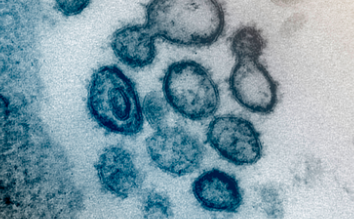
FILE PHOTO: The ultrastructural morphology exhibited by the 2019 Novel Coronavirus (2019-nCoV) is seen in an illustration released by the Centers for Disease Control and Prevention (CDC) in Atlanta, Georgia, U.S. January 29, 2020. Alissa Eckert, MS; Dan Higgins, MAM/CDC/Handout via REUTERS./File Photo

Several recent studies have shown that certain variants of the novel coronavirus can undermine immune protection from antibodies and vaccines.

But antibodies - which block the coronavirus from attaching to human cells - may not tell the whole story, according to the study by researchers at the National Institute of Allergy and Infectious Diseases (NIAID). T cells appear to play an important additionally protective role.

“Our data, as well as the results from other groups, shows that the T cell response to COVID-19 in individuals infected with the initial viral variants appears to fully recognize the major new variants identified in the UK, South Africa and Brazil,” said Andrew Redd of the NIAID and Johns Hopkins University School of Medicine who led the study.

The researchers analyzed blood from 30 people who had recovered from COVID-19 before the emergence of the new more contagious variants.

From those samples, they identified a specific form of T cell that was active against the virus, and looked to see how these T cells fared against the concerning variants from South Africa, the UK and Brazil.

They found the T-cell responses remained largely intact and could recognize virtually all mutations in the variants studied.

The findings add to a prior study that also suggested T cell protection appears to remain intact against the variants.

The NIAID researchers said larger studies are needed to confirm the findings. Continued monitoring for variants that escape both antibody and T cell protection is needed, Redd said.

The paper has been accepted for publication in Open Forum Infectious Diseases but has yet to be peer reviewed.

Reporting by Julie Steenhuysen; Editing by Bill Berkrot

Let's block ads! (Why?)


"virus" - Google News
March 31, 2021 at 05:51AM
https://ift.tt/3m6er5e

T cells induced by COVID-19 infection respond to new virus variants: U.S. study - Reuters
"virus" - Google News
https://ift.tt/2OagXru

Featured Post

Measles is “growing global threat,” CDC tells doctors in alert message - Ars Technica

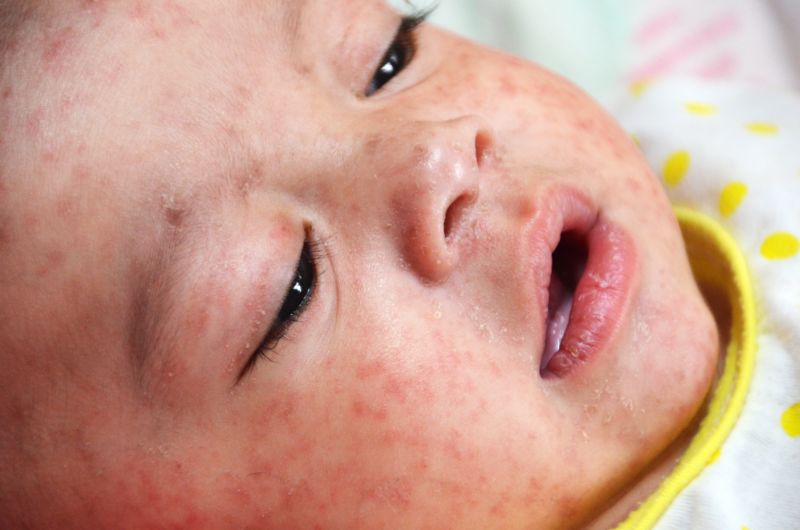
Enlarge / A baby with measles. CDC The Centers for Disease Control and Prevention is putting clinicians on alert about the growing r...

Popular Posts