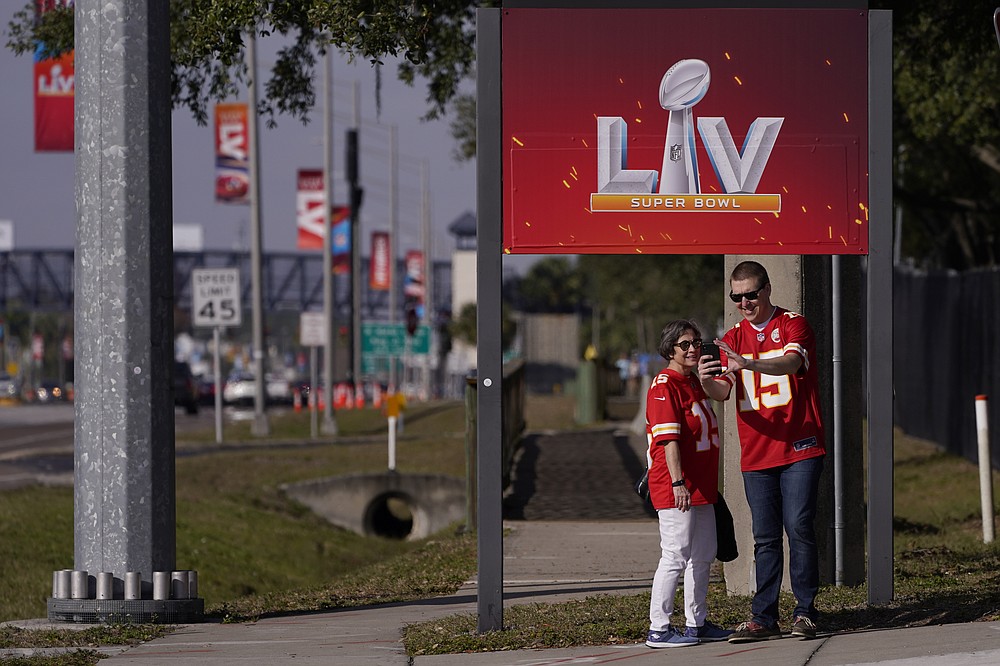
Kansas City Chiefs superfan Ty Rowton hugged strangers in the streets of Miami last year after watching his team win the Super Bowl and then joined hundreds of thousands of fans back home at a victory parade, thinking little of a mysterious virus that his buddies were beginning to talk about.
The championship seems like a lifetime ago. Today the Chiefs are playing in the Super Bowl again, and the virus has morphed into a once-in-a-century pandemic that has health officials on edge as fans congregate at parties and bars for the big game.
The nation's top health officials sounded the alarm last week about the Super Bowl being a potential super-spreader event, and they urged people to gather with friends over Zoom, not in crowds.
"I'm worried about Super Bowl Sunday, quite honestly. People gather, they watch games together. We've seen outbreaks already from football parties," said Rochelle Walensky, head of the Centers for Disease Control and Prevention.
[Video not showing up above? Click here to watch » https://www.youtube.com/watch?v=L9as3_iiCXw]
Walensky urged Americans to watch the game with others "only virtually, or with the people you live with." For those who still want to gather, the CDC suggested hosting an outdoor viewing party, watching the game on a projector screen, where people from different households can sit at least 6 feet apart.
The Super Bowl is taking place as the nation sees a dramatic drop in new virus cases -- a sign that the infection spike from holiday gatherings is easing. The seven-day rolling average is trending down in almost every part of the United States; nationally, the total went from about 180,000 on Jan. 22 to about 126,000 on Friday, according to Johns Hopkins University.
Health officials fear the game could seed new cases at exactly the wrong time. Just last week, the new coronavirus strain that spread quickly in the United Kingdom was confirmed in Kansas after turning up in numerous other states. Other highly contagious variants also have scientists worried. States are in a race to vaccinate before the newcomers become widespread and additional strains emerge.
MASK ORDINANCE
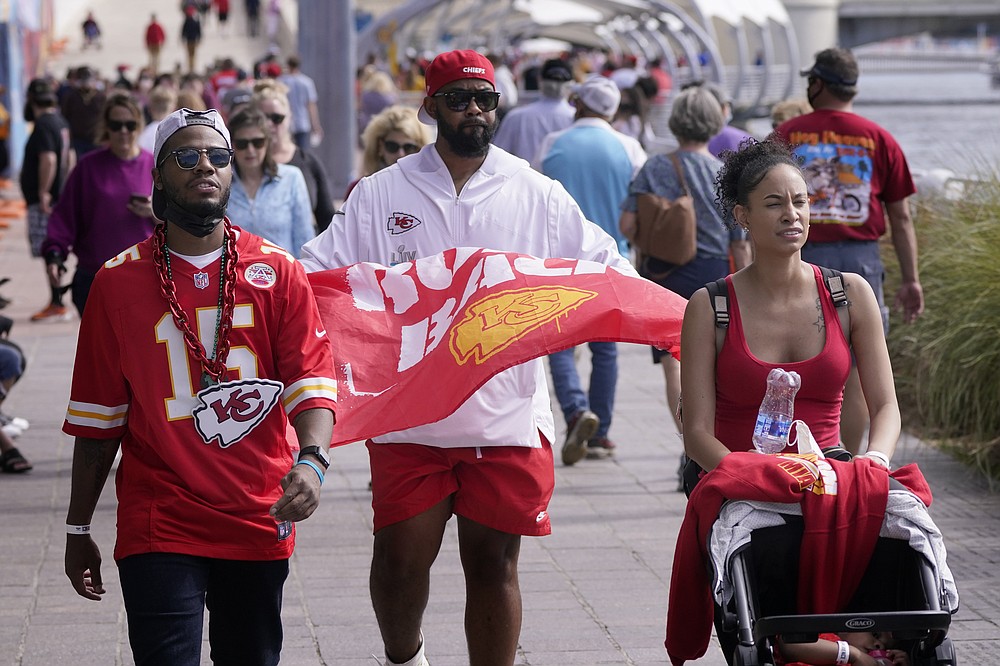
After a long year of shutdowns, it remains to be seen whether Americans will heed the warnings for the Super Bowl, an event that was watched by more than 100 million people last year.
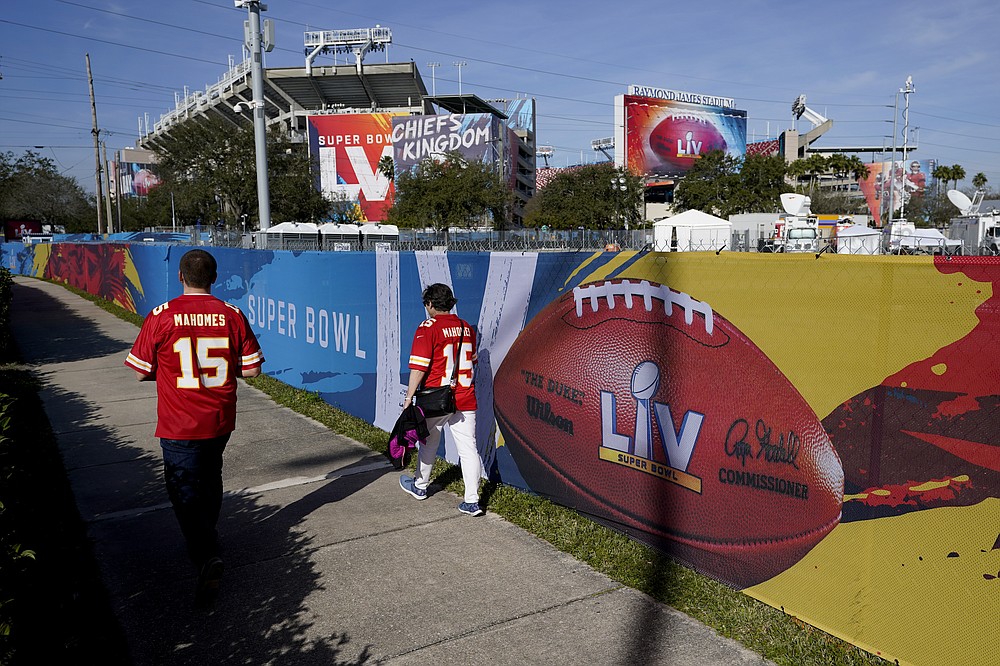
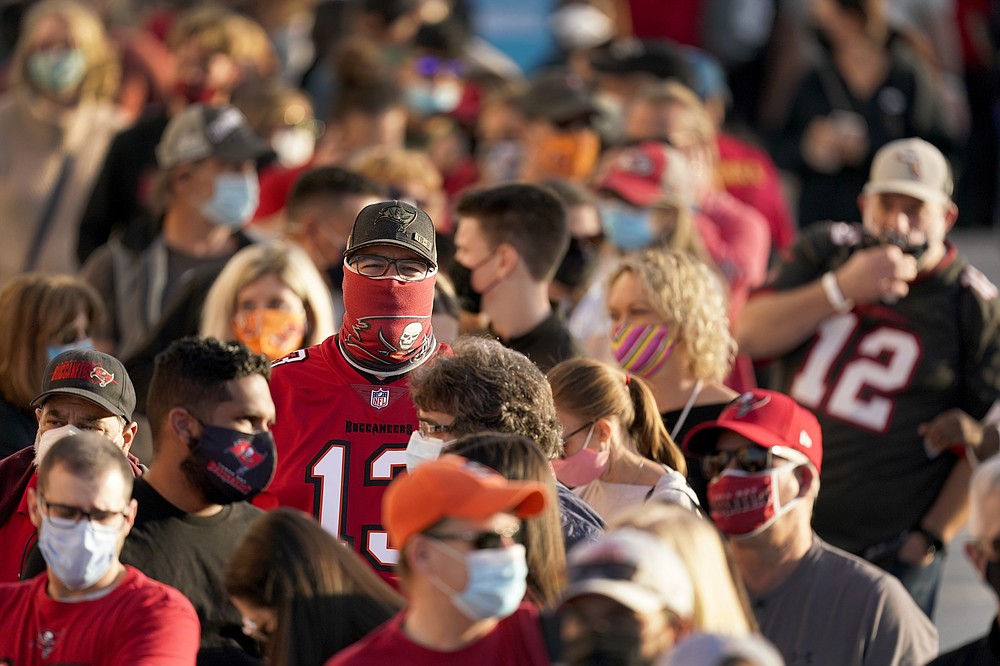
The game will be played in front of about 22,000 fans in Tampa, many of them vaccinated health workers.
Tampa Mayor Jane Castor announced a temporary ordinance requiring that masks be worn outside in several popular gathering spots. The order states that violators could be fined $500 as a "last resort."
Another ordinance requires masks at any indoor site when social distancing is not possible. That would include many bars and restaurants but not private residences.
The city acquired 150,000 donated masks that officials are giving out to anyone who needs one. The slogan is "need a mask, just ask."
Castor said she is keenly aware that the goal is to prevent the game from becoming an event that triggers a spike in infections. "We are hosting an event that is going to be the most-watched sporting event in the entire world," she said. "We have got to get this right."
Castor released a video with Kansas City, Mo., Mayor Quinton Lucas urging caution, and the Kansas Hospital Association enlisted the Chiefs' play-by-play announcer to do a public service announcement urging health precautions.
"Don't fumble this. We're almost there," said Dr. Mark Ghaly, health and human services secretary in California, where officials and experts fear that large watch parties could imperil the state's precarious emergence from the worst wave of the pandemic. "Let's keep our guard up a little bit longer."
"If we ... end up having large numbers of people in our home, inside, not masked, yelling for our teams, then we can see a potential reversal of the downward trend and end up with a new surge," agreed Dr. Robert Kim-Farley, medical epidemiologist and infectious diseases expert at the UCLA Fielding School of Public Health. "This Super Bowl is not the time to have a large party. Wait until next year."
Gallery: Coronavirus scenes, 2-6-2021[Gallery not loading above? Click here for more photos » arkansasonline.com/27covid19/]
TESTING APPROACH
When a Halloween party sparked a covid-19 outbreak at North Carolina A&T State University, school officials conducted rapid screening on more than 1,000 students in a week, including many who didn't have symptoms.
Although such asymptomatic screening isn't approved by regulators and the 15-minute tests aren't as sensitive as the genetic one that can take days to yield results, the testing director at the historically Black college credits the approach with quickly containing the infections and allowing the campus to remain open.
"Within the span of a week, we had crushed the spread. If we had had to stick with the PCR test, we would have been dead in the water," said Dr. Robert Doolittle, referring to the polymerase chain reaction test that is considered the gold standard by many doctors and Food and Drug Administration regulators.
With President Joe Biden vowing to get elementary and middle school students back to the classroom by spring and the country's testing system still unable to keep pace with the spread of the virus, some experts see an opportunity to refocus U.S. testing less on medical precision than on mass screening that they believe could save hundreds of thousands of lives.
As vaccines slowly roll out, they say the nation could suppress the outbreak and reopen much of the economy by easing regulatory hurdles to allow millions more rapid tests that, while technically less accurate, may actually be better at identifying sick people when they are most contagious.
"Our whole testing approach, which has failed, has tried to tackle this pandemic as though it's a bunch of little medical problems," said Dr. Michael Mina, a Harvard University testing specialist. "Instead, we need to take a big step back and say, 'Wait, this isn't a lot of medical problems, it's an epidemic. And if we resolve the epidemic, we resolve the medical problems.'"
The U.S. reports about 2 million tests per day, the vast majority of which are the slower, PCR variety. The initial tests all used the cutting-edge technique, which quickly became the standard at U.S. hospitals and labs. It also became the benchmark for accuracy at the FDA, which has approved more than 230 PCR tests but only about a dozen rapid tests. Priced as low as $5, the quick tests look for viral proteins, which are generally considered a less rigorous measure of infection.
The FDA said it supports "innovation in testing" and "has not hesitated" to make rapid tests available. But most experts agree that the current U.S. system, which relies heavily on lab testing, is still incapable of containing the virus that is killing more than 3,000 Americans per day.
Compounding the problem is that an estimated 40% of people infected don't develop symptoms. It's among these silent spreaders that Mina says rapid tests have the clear advantage over lab tests.
With its medical precision, he argues that the PCR test continues to detect covid-19 in many people who have already fought off the virus and are no longer contagious. The rapid test, while less sensitive, is better at quickly catching the virus during the critical early days of infection when it can spread explosively through communities.
The case for widescale rapid testing is getting a boost from universities and school systems that have used the approach to stay open through the latest waves of the pandemic. And proponents point to apparent success stories like the small European nation of Slovakia, which saw infections drop after screening two-thirds of its roughly 5 million people with the tests.
'LOT OF GRAY'
But many lab specialists worry about vastly expanding the use of rapid tests, which are more prone to false results, and have never been used at the large scale being proposed.
"There's a lot of people trying to portray things as black-and-white, and there's a lot of gray here, unfortunately," said Susan Butler-Wu of the University of Southern California's Keck School of Medicine.
She points out that testing campaigns in Slovakia, the U.K. and elsewhere have been paired with strict lockdown orders. Without such measures in the U.S., critics say there is no way to predict whether people who test positive will self-isolate.
That's a particular worry with proposals from Mina and others to blanket the U.S. in millions of rapid, home tests that would allow people to regularly screen themselves without medical supervision.
"I want to believe in people making good decisions when left to their own devices," said Butler-Wu. "But the fact that we are where we are right now really shows you people don't make good decisions when left to their own devices."
[CORONAVIRUS: Click here for our complete coverage » arkansasonline.com/coronavirus]
One area where consensus may be emerging is in public schools, where many parents and districts are eager for a return to in-person instruction. Biden has proposed spending $50 billion to vastly expand rapid testing as part of his push to return most kindergarten-through-eighth-grade students to classes within his first 100 days.
One of his first executive orders called for using the Defense Production Act to scale up supplies needed for rapid tests. And key members of his administration, including the surgeon general and head of the CDC, vigorously support a revamped testing strategy focused on such screening. Last week, the White House said it enlisted six manufacturers to mass-produce the tests, with the goal of providing 60 million by the end of the summer.
Biden's team has been in discussions with the nonprofit Rockefeller Foundation, which has outlined a plan to use 300 million tests per month to return most U.S. students to the classroom beginning in March.
Information for this article was contributed by Heather Hollingsworth, Curt Anderson, John Hanna and Matthew Perrone of The Associated Press; by Lazaro Gamio of The New York Times; and by Luke Money, Sean Greene, Rong-Gong Lin II, Jaweed Kaleem and Ryan Menezes of the Los Angeles Times (TNS).



"virus" - Google News
February 07, 2021 at 06:43PM
https://ift.tt/3rw8oIJ
Super Bowl is feared to run up virus count - Northwest Arkansas Democrat-Gazette
"virus" - Google News
https://ift.tt/2OagXru



No comments:
Post a Comment