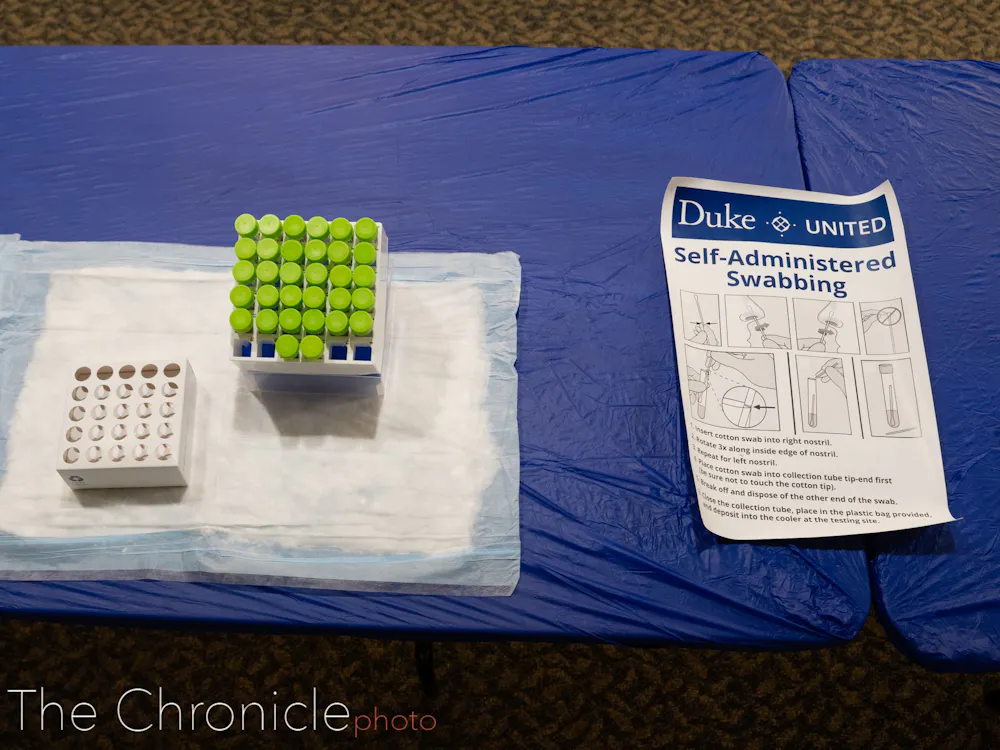
The B.1.1.7 variant of the coronavirus, first found in the United Kingdom, has been identified for the first time on campus, according to Professor of Biology Gregory Wray, director of the Center for Genomic and Computational Biology.
Current research indicates that this form of the virus may be more transmissible and more deadly than the original variant discovered in Wuhan.Scientists believe vaccines will still work against virus variants, if not as well, although there is yet to be conclusive research on the subject.
The variant was identified last week, Wray said.
Until now, the California and New York variants were the only novel variants of the virus identified on campus. The California variant may be more likely to cause severe illness and death, and the New York variant may be more resistant to some current treatments and vaccines.
Despite mutations being found on campus, COVID-19 surveillance tests remain accurate, explained Professor of Medicine Thomas Denny, chief operating officer for the Duke Human Vaccine Institute.
“We test other regions of the virus that are not impacted by development of variants. So, we will be able to identify virus as it changes its molecular signature over time,” Denny wrote in an email.The B.1.1.7 variant of the virus that causes COVID-19, first found in the United Kingdom, has been identified for the first time on campus, according to Professor of Biology Gregory Wray, director of the Center for Genomic and Computational Biology.
Current research indicates that this form of the virus may be more transmissible and more deadly than the original variant discovered in Wuhan.Scientists believe vaccines will still work against virus variants, if not as well, although there is yet to be conclusive research on the subject.
The variant was identified last week, Wray said.
Until now, the California and New York variants were the only novel variants of the virus identified on campus. The California variant may be more likely to cause severe illness and death, and the New York variant may be more resistant to some current treatments and vaccines.
Despite mutations being found on campus, wrote-19 surveillance tests remain accurate, wrote Professor of Medicine Thomas Denny, chief operating officer for the Duke Human Vaccine Institute, in an email.
“We test other regions of the virus that are not impacted by development of variants. So, we will be able to identify virus as it changes its molecular signature over time,” Denny wrote.
Get The Chronicle straight to your inbox
Signup for our editorially curated, weekly newsletter. Cancel at any time.
"virus" - Google News
March 25, 2021 at 09:50AM
https://ift.tt/3vZdNLy
UK virus varient identified in campus test results - Duke Chronicle
"virus" - Google News
https://ift.tt/2OagXru



No comments:
Post a Comment